2026 High-Volume Enterprise Document Processing for AI Agents
See how Seahorse Cloud makes high-volume PDFs and images RAG-ready without separate preprocessing, with managed agents and on-premises or SaaS deployment.
Key Takeaway
- Eliminate custom preprocessing pipelines: Seahorse Cloud enables RAG over large volumes of unstructured documents without a separate preprocessing pipeline and immediately returns a 401 authentication failure for deleted API keys.
- Unify ingestion and vector synchronization: Built-in semantic chunking connects directly with document parsing, embedding, and vector database synchronization to reduce the separate components your team must maintain.
- Separate delivery from hosting location: Evaluate commercial delivery and infrastructure independently, as the platform supports on-premises installation and SaaS subscriptions that can also be deployed on premises.
When your organization needs to run AI agents over large volumes of unstructured documents like PDFs and image files, extracting text is only the first hurdle. When a document processing workflow stops at raw output, teams still evaluate how to connect chunking logic, embedding pipelines, vector database synchronization, and agent execution frameworks before anyone can query the data.
Built for Unstructured Document Volumes
Seahorse Cloud is built for organizations that need Retrieval-Augmented Generation (RAG) over large volumes of unstructured documents, including PDFs and images, without building a separate preprocessing pipeline. It transforms unstructured documents into AI-ready knowledge through autonomous parsing, semantic chunking, and intelligent agents.
This platform is intended for developers, platform and AI teams, and enterprise decision-makers evaluating document-to-agent workflows, operational responsibilities, integration, and deployment requirements. Instead of treating document capture as an isolated back-office task, you can evaluate how files move from storage to active agent responses within a single operational boundary.
Turning Documents into RAG Knowledge
Seahorse Cloud AI-based storage combines S3-compatible object storage with autonomous document parsing using Vision-Language Models (VLM), Optical Character Recognition (OCR), and Large Language Models (LLM), alongside semantic chunking and automatic vector database synchronization. By integrating semantic chunking with document parsing, embedding, and vector synchronization inside the document-ingestion workflow, the platform reduces the separate components your team must connect.
When you create a Storage instance, the platform creates a dedicated Table and index. It then chunks and embeds uploaded files and loads them into that generated Table. While native semantic chunking is built into the document-ingestion workflow to reduce separate connection components, the term "native" only describes where the function executes; it does not by itself specify how headings, tables, or section boundaries are preserved. If your documents rely on complex layout structures, you should test how specific file formats chunk during evaluation rather than assuming universal layout preservation.
You also need to account for how access controls behave after ingestion. Automatic vector database synchronization and document permission updates are handled separately. Because these two processes are handled separately, your team must plan permission governance as a distinct operational step.
Full-Stack Managed RAG Architecture
Seahorse Cloud is a full-stack managed RAG platform covering object-storage management, a vector database, an autonomous parser, and a managed agent system. At the core of its retrieval layer is Seahorse Database, a container-based managed vector database with a built-in control plane, multi-tenant isolation, table and schema management, real-time monitoring, and API-key authentication, supporting NVMe optimization and VDPU acceleration.
When you provision Seahorse Storage, you need to separate index-time commitments from query-time flexibility. Upon creating a Storage instance, the embedding endpoint, dimension, M, and EF Construction parameters are fixed. However, as long as the required endpoints are configured, you can adjust query-time controls such as search mode, Top K, EF Search, and RRF K without creating a new Storage instance.
Operating Agents on RAG Data
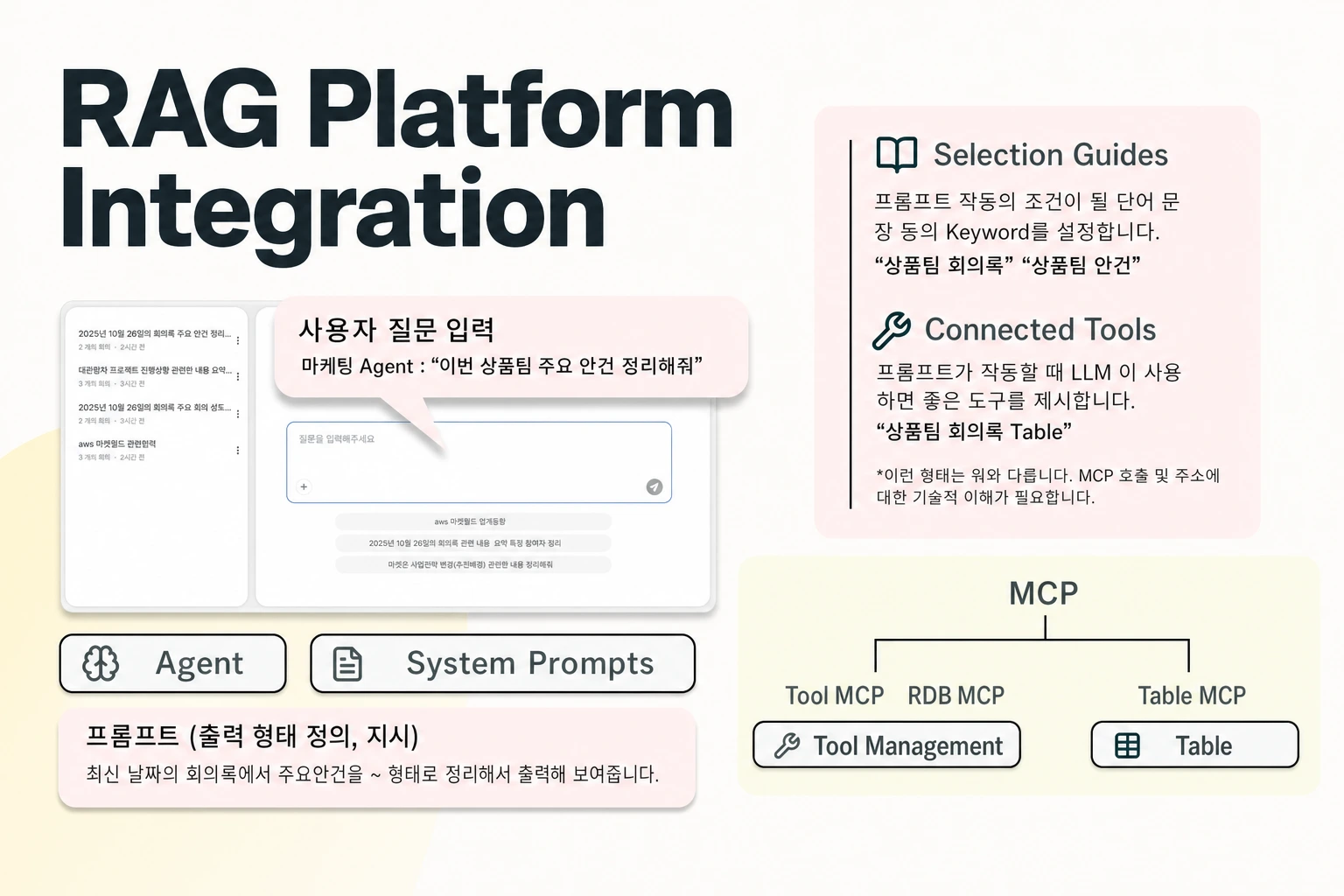
Once your documents are indexed, Seahorse Cloud managed agents support MCP-standard tool calls, inference endpoint APIs, and usage tracking on top of the vector database and RAG. The platform divides these operational responsibilities into three distinct areas:
- RAGOps covers RAG pipeline composition, integrated operation, and monitoring.
- AgentOps covers AI-agent creation, deployment, management, and monitoring.
- Model Context Protocol (MCP) supports data and tool integration for both RAGOps and AgentOps.
Within this framework, managed agents support MCP-standard tool calls, inference endpoint APIs, and usage tracking on top of the vector database and RAG. Specifically, Seahorse Agent is an MCP-standard cross-platform agent that supports tool integration and context memory, including cross-session context memory. This allows your team to support MCP-standard tool calls and inference endpoint APIs while maintaining context memory across sessions.
When securing these agents, platform administrators must pay close attention to how user lists and API keys behave in practice. In the agent user settings, when Require Authentication is turned on and the selected user list is empty, the system allows all authenticated tenant users; deleting the last selected user does not result in a deny-all state. If you intend to restrict an agent to nobody, simply emptying the allowed user list will instead open it to every authenticated user in your tenant.
Similarly, API key lifecycle management operates at the credential level rather than the document level. Calls made using a deleted API key immediately receive an authentication failure (401), and deleting a key only revokes that specific credential without setting document-level permissions for other users or keys.
Evaluating Delivery and Hosting Options
Seahorse Cloud has a Kubernetes-native architecture using standard resources and is available as an on-premises installation or a SaaS subscription. Crucially, the commercial delivery model and the hosting location are separate dimensions, meaning the SaaS offering can also be deployed on premises.
When you use the SaaS service, you operate it through a control console. If your data governance policies forbid external hosting, you can still evaluate whether a subscription model or a traditional on-premises installation fits your operational structure while keeping the workload on premises. Public-sector and regulated organizations in South Korea that require domestic on-premises deployment or domestic GS certification software are also included in the target audience. Reviewing these delivery and hosting dimensions separately ensures your architecture team and procurement team align on both infrastructure control and commercial terms before deployment.
FAQS
FAQ
Which teams and organizations is Seahorse Cloud built to support?
It is designed for developers, platform and AI teams, and enterprise decision-makers evaluating document-to-agent workflows, operational responsibilities, integration, and deployment requirements. It also serves public-sector and regulated organizations in South Korea that need on-premises deployment or GS certification software.
Can we adjust retrieval search parameters later without re-ingesting our documents?
Yes, as long as the required endpoints are configured, you can change query-time controls such as search mode, Top K, EF Search, and RRF K without creating a new Storage instance. Only the embedding endpoint, dimension, M, and EF Construction values are locked when the Storage instance is first created.
Does revoking an API key or updating source files automatically restrict document access?
No, neither action automatically restricts document-level access for other users or keys.
지금 체험
See how these criteria hold up on the real thing.