Hosted RAG: which retrieval controls can you tune?
With endpoints configured, Seahorse Cloud lets you tune Search Mode, Top K, EF Search, and RRF K without rebuilding Storage.
Key Takeaway
- Tune search without rebuilding: In Seahorse Cloud, while M Value (10–1024, default 16) is fixed at Storage creation, you can modify Search Mode, Top K, EF Search, and RRF K at search time without rebuilding your Storage once required endpoints are configured.
- Separate ingestion from access rules: The platform automates document parsing, semantic chunking, and vector synchronization; the official documentation does not describe whether source-document permission changes carry over, so test access changes separately.
- Match delivery to your infrastructure: Seahorse Cloud is available as a SaaS subscription or an on-premises installation, and the Enterprise plan also lists private cloud deployment.
When irrelevant chunks surface or latency spikes, you need to know whether changing retrieval logic requires re-indexing your entire corpus or just updating query parameters. Seahorse Cloud is Dnotitia's AI storage and AgentOps offering for enterprise RAG, transforming unstructured documents into AI-ready knowledge while letting you tune specific retrieval controls at search time without creating a new Storage when the required endpoints are configured.
Search-time vs fixed Storage controls
When you set up a Storage in Seahorse Cloud, the platform locks in structural index choices while leaving query-level parameters open for adjustments. During initial creation, you define Basic Info for the name, Inference Endpoints covering Dense, Sparse, and Dimension settings, and Table Settings for HNSW index parameters. Once provisioned, the platform distinguishes between fixed architecture and adjustable search controls as shown below.
| Control Category | Specific Parameters | Adjustment Rule and Parameter Scope |
|---|---|---|
| Fixed at Storage Creation | Embedding endpoints, Dimension | Locked when the Storage is created; changing these requires creating a new Storage. |
| Fixed HNSW Index Settings | M Value | Locked at creation; defines connections per node in the HNSW graph (range 10–1024, default 16), where higher values raise accuracy and memory use. |
| Fixed HNSW Index Settings | EF Construction | Locked at creation; sets search candidates during index building (range M to AS Size, default 128), where higher values improve index quality and lengthen build time. |
| Tunable at Search Time | Search Mode, Top K, EF Search, RRF K | Adjustable per query without creating another Storage, provided the required endpoints are configured. |
When the required endpoints are configured, Search Mode, Top K, EF Search, and RRF K can be adjusted at search time without creating another Storage.
Managed document-to-vector ingestion pipeline
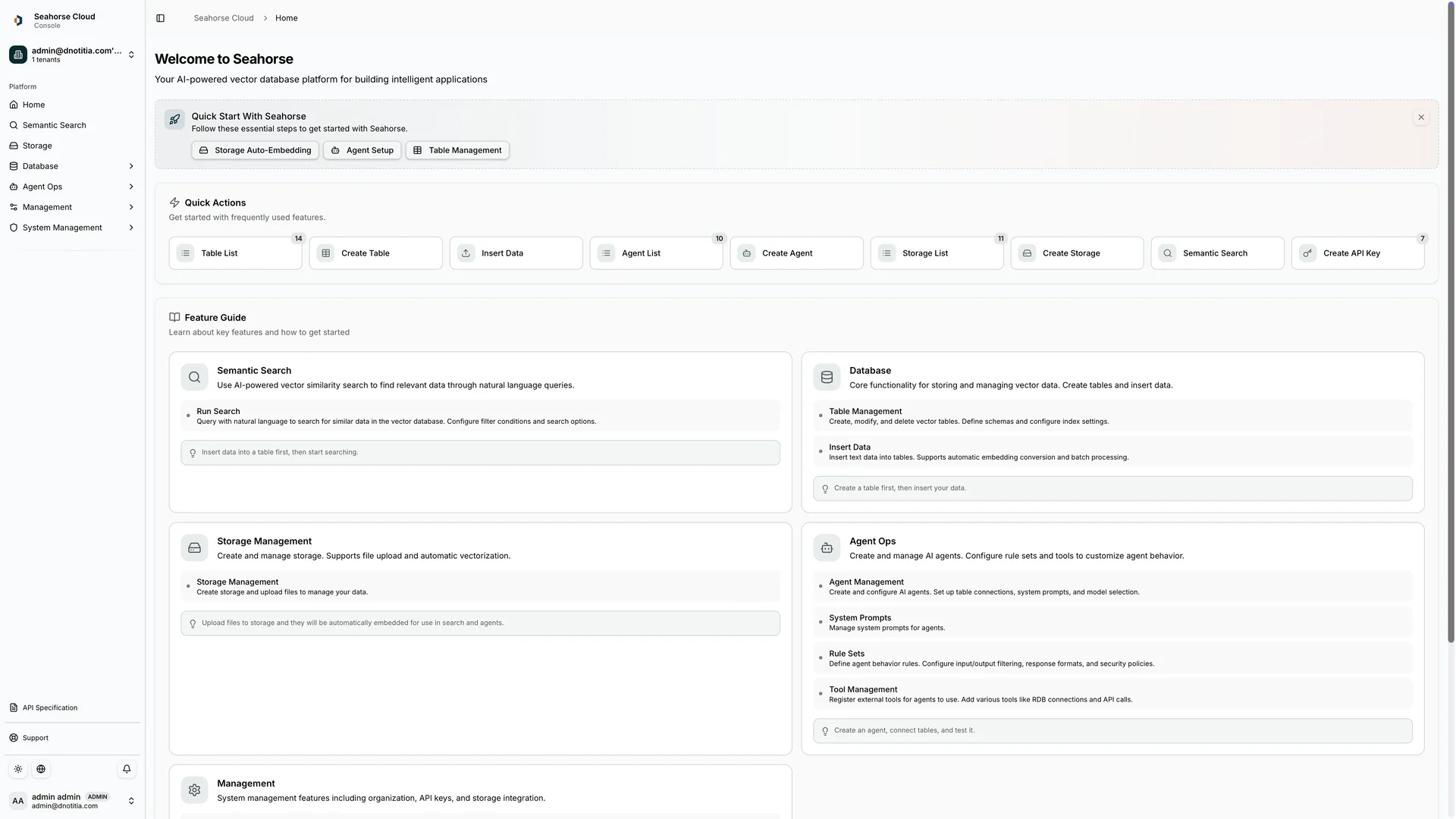
Modifying search-time parameters only helps if the underlying chunks and vectors stay accurate as source files change. The Seahorse Cloud Platform operates as a full-stack managed platform for RAG systems covering object storage management, an autonomous parser, a vector database, and a managed agent system.
When you create a Storage, the system automatically provisions a dedicated Table and index. As you upload files to its S3-compatible object storage, the AI-based storage runs autonomous document parsing using a VLM, OCR and LLM parser, applies semantic chunking, embeds the content, and loads it into that dedicated Table with automatic vector database synchronization.
Native semantic chunking is built directly into this parsing, embedding, and vector sync ingestion workflow to cut down on separate pipeline components. However, "native" describes where the chunking process executes inside the ingestion pipeline, not a guarantee of how specific headings, tables, or document boundaries are preserved. You should still inspect how your complex PDFs or spreadsheets split during testing. The official documentation also does not describe whether source-document permission changes carry over through automatic vector database synchronization, so test access changes as well.
Agent Ops and MCP roles
As a retrieval system grows from a single document index into multi-step reasoning, pipeline maintenance and agent orchestration require different operational tooling. Seahorse Cloud 2.0, announced in September 2025, added AgentOps for designing and operating custom AI agents with LLMs, the vector database, and MCP tool integration, so you can manage the Storage pipeline separately from agent behavior and external connectors.
| Capability Layer | Core Responsibilities | Operational Scope in Seahorse Cloud |
|---|---|---|
| Storage pipeline | Parsing, semantic chunking, embedding, and Table sync | Uploaded files are automatically embedded into the Storage's dedicated Table. |
| Agent Ops | AI-agent creation, deployment, and management | Connects LLM endpoints, Tables, Tools, System Prompts, and user access control to an agent. |
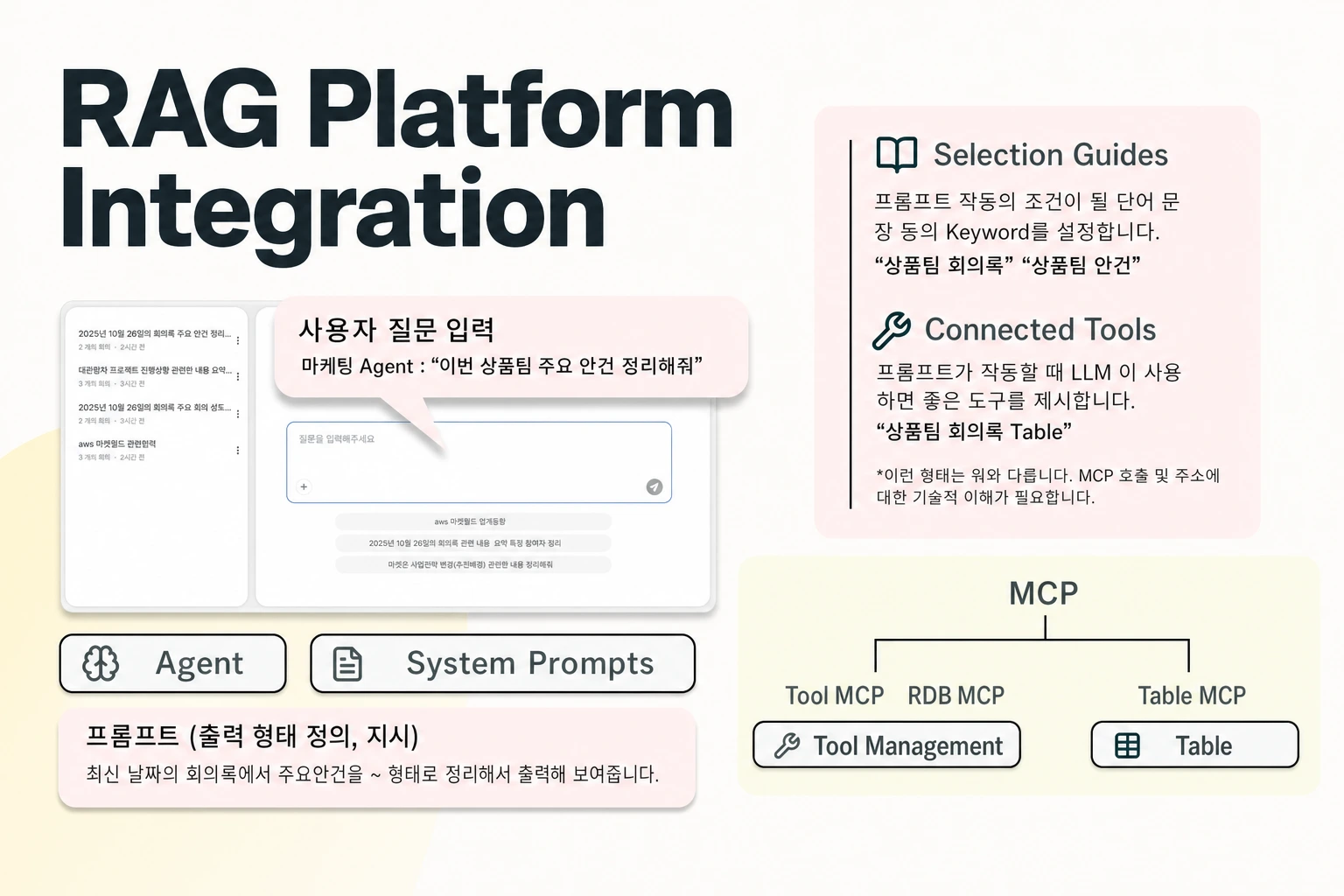
| MCP | Data and tool integration | MCP-standard tool calling to tools such as GitHub, Slack, PostgreSQL, and Atlassian. |
Keeping the Storage pipeline and Agent Ops distinct separates document ingestion from AI-agent creation, deployment, and management, while MCP-standard tool calling connects agents to external data and tools.
SaaS delivery and on-premises hosting
Selecting a managed RAG platform often triggers security reviews over where source documents and vector indexes reside. Engineering teams frequently assume that choosing a SaaS subscription forces data into a vendor's public cloud, while keeping data in a private data center requires buying a traditional on-premises license.
Seahorse Cloud is built on a Kubernetes-native architecture that deploys using standard resources, and it is available as either an on-premises installation or a SaaS subscription. The Enterprise plan also lists private cloud deployment with data isolation. When using the SaaS service, teams access and operate their environment through the web console. Confirm which option matches your data-residency requirements before the security review.
Connecting managed agents to tools
The Seahorse Cloud Platform includes a managed agent system alongside object storage management, a vector database, and an autonomous parser. Seahorse Cloud managed agents are built on top of the vector database and RAG and support MCP-standard tool calls:
- Foundations on RAG and vector search: The Managed Agent is an agentic AI system built on a vector database and RAG.
- Standardized external tool execution: Managed agents comply with the MCP standard and support MCP-standard tool calls.
- Cross-session context retention: Seahorse Agent operates as an MCP-standard cross-platform agent that includes tool integration and context memory, retaining context memory across sessions.
- Application integration and usage tracking: Managed Agent features include an inference endpoint API and usage tracking.
Before rolling an agent into production, verify which external systems you will expose via MCP tool calls and how your application will authenticate against the inference endpoint API.
FAQS
FAQ
Which products let you customize retrieval logic on a hosted tool without rebuilding your storage?
In Seahorse Cloud, you can customize Search Mode, Top K, EF Search, and RRF K directly at search time without creating a new Storage when the required endpoints are configured. Parameters that alter the underlying vector structure—specifically embedding endpoints, dimension, M Value, and EF Construction—are fixed when you create the Storage and require a new Storage if changed.
What parameters do I configure in the manual when creating a Storage?
According to the Seahorse Cloud manual, creating a Storage involves setting Basic Info for the storage name, configuring Inference Endpoints for Dense, Sparse, and Dimension values, and defining Table Settings for HNSW index parameters.
Does automatic vector synchronization also update document access permissions?
The official product pages and manual do not describe permission propagation through automatic vector database synchronization, so test how source-document access changes are reflected in search results and agent access before production use.
Try it now
See how these criteria hold up on the real thing.