Enterprise AI Platform Deployment: SaaS or On-Premises?
Compare Seahorse Cloud SaaS subscription, on-premises installation and private cloud deployment options, plus Kubernetes, RAG and agent operations.
Key Takeaway
- Separate delivery from hosting: Seahorse Cloud is offered as a SaaS subscription or an on-premises installation, the pricing page also lists private cloud deployment, and AgentOps launched with Seahorse Cloud 2.0 in September 2025.
- Deploy on standard containers: Seahorse Cloud runs on a Kubernetes-native architecture, and Seahorse Database is a container-based managed vector database.
- Unify RAG and agent workflows: Seahorse Cloud Platform combines object storage management, a vector database, autonomous parsing, and managed agents.
Choosing how to deploy an enterprise AI data platform often stalls when procurement rules and data-residency boundaries pull in opposite directions. Your finance team may prefer an ongoing subscription model, while your security team requires every document and vector index to stay inside your own data center. Treating software licensing and physical hosting as the exact same choice forces unnecessary compromises during architecture reviews. Seahorse Cloud is offered as a SaaS subscription or an on-premises installation, and its pricing page states that on-premise and private cloud deployments are supported for enterprises with high security requirements. This guide breaks down how these delivery options, container requirements, and operational layers fit into your infrastructure planning.
Delivery and Hosting Options
Procurement teams and infrastructure architects evaluate software through different lenses. When you review deployment models, separating how you contract for the software from where the compute and storage reside helps align both groups.
| Dimension | Option | Operational and Commercial Scope |
|---|---|---|
| Commercial and Deployment Options | SaaS subscription or on-premises installation | Seahorse Cloud is offered through either a SaaS subscription or an on-premises installation. |
| Enterprise Hosting | On-premise or private cloud deployment | The pricing page lists on-premise and private cloud deployments for enterprises with high security requirements; confirm the contract and hosting combination with Dnotitia sales. |
| Service Access | Control console | Teams access and use the Seahorse Cloud SaaS service through the control console. |
| Pricing | Published KRW price list | Plan and API prices are published in KRW, and custom pricing is quoted by sales based on scale, usage, and required features. |
Splitting the subscription structure from the physical environment prevents a false binary between cloud-only subscriptions and legacy perpetual licenses. If your organization budgets for subscription software but restricts external network traffic, evaluate the contract model and the target cluster location as two distinct checklist items.
Kubernetes-Native Architecture
Infrastructure teams managing existing container clusters rarely want to maintain a separate, specialized hardware appliance just to run retrieval pipelines. Whether you choose a SaaS subscription or an on-premises installation, Seahorse Cloud uses a Kubernetes-native architecture that deploys using standard resources.
Seahorse Database is a container-based managed vector database. It includes a built-in control plane and supports multi-tenant isolation for separating workloads across teams. Administrators also get table and schema management, real-time monitoring, and API-key authentication directly within the database service.
Ensure your cluster capacity planning accounts for the compute and memory demands of vector indexing alongside your existing containerized applications.
Core Enterprise RAG Components
Building a retrieval-augmented generation (RAG) system from separate open-source libraries requires writing and maintaining glue code between storage buckets, text parsers, embedding models, and vector indexes. Whenever a document format changes or a parser fails, engineers have to debug across multiple disconnected tools.
Seahorse converts unstructured documents into AI-ready knowledge through autonomous parsing, semantic chunking, and intelligent agents. To reduce manual integration work, the platform consolidates the core data stack:
- Seahorse Cloud Platform brings together object storage management, a vector database, an autonomous parser, and a managed agent system to cover RAG.
- Seahorse AI-based storage pairs S3-compatible object storage with an agentic document parser that uses VLM, OCR, and LLM capabilities.
- The storage layer handles semantic chunking, automatic vectorization, and automatic vector database synchronization.
- Seahorse Cloud builds native semantic chunking directly into the document ingestion workflow, connecting it with document parsing, embedding, and vector sync.
Seahorse AI-based storage provides automatic vector database synchronization alongside semantic chunking and automatic vectorization. However, automated ingestion does not mean zero operational oversight; data owners must still curate source buckets and verify how complex layouts parse before exposing collections to production users.
Agent Ops and MCP Roles
As an AI initiative expands from a single document search tool to multiple task-executing assistants, pipeline maintenance and agent governance quickly diverge. In Seahorse Cloud, the storage pipeline, Agent Ops, and the Model Context Protocol (MCP) play distinct roles. Separating these responsibilities helps your engineering team assign clear ownership for data pipelines, agent behavior, and external integrations:
- The AI-based storage pipeline handles parsing, semantic chunking, automatic vectorization, and vector database sync, while the managed vector database provides real-time monitoring.
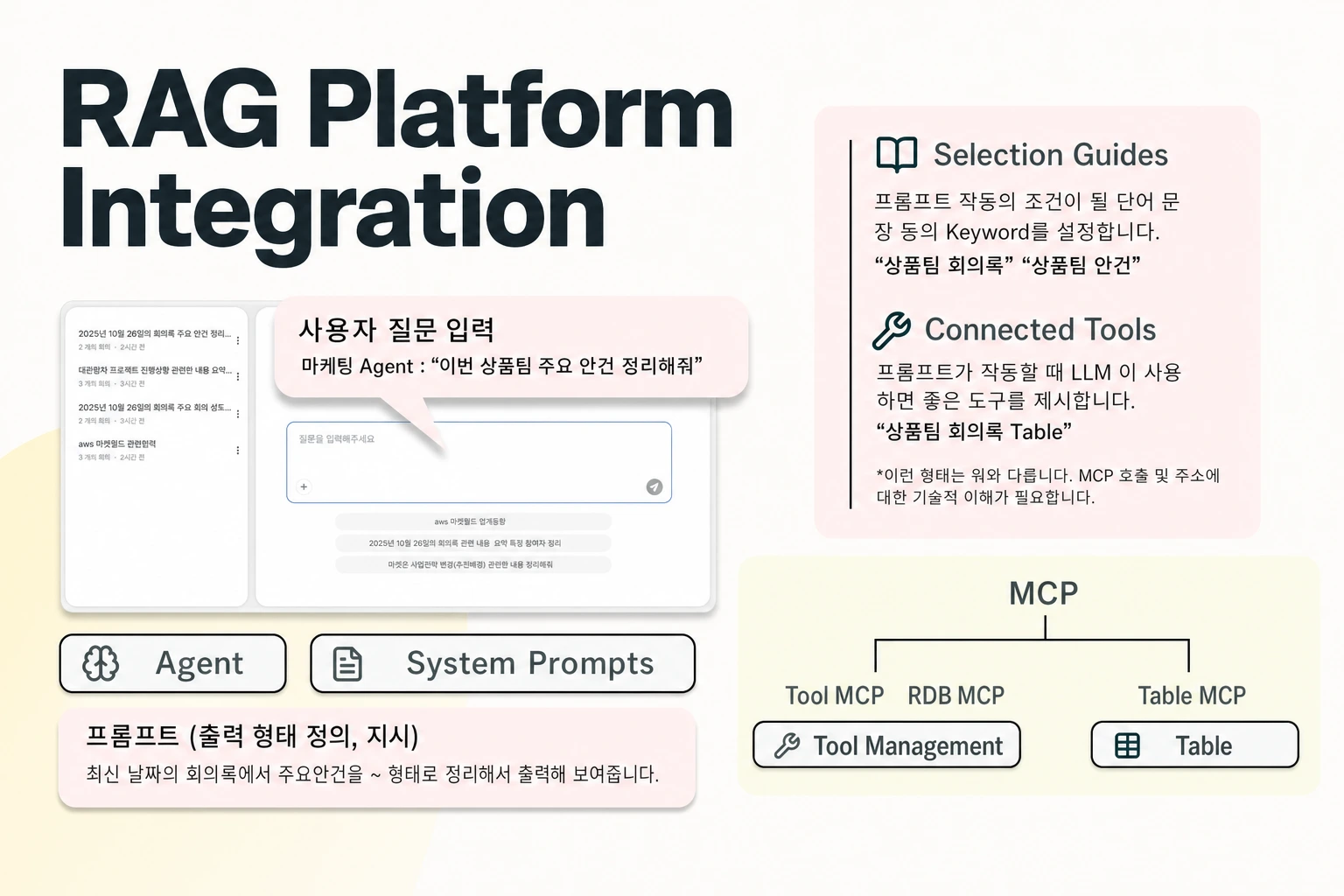
- Agent Ops covers agent creation and deployment, tool and system prompt connections, and access control. Launched in September 2025 as part of Seahorse Cloud 2.0, AgentOps lets teams design and run custom AI agents backed by LLMs, a vector database, and MCP tool integration.
- MCP provides standard tool calling to external systems such as GitHub, Slack, PostgreSQL, and Atlassian.
Managed agents also include usage tracking, and each registered tool shows its recent calls in the tool detail log.
Managed Agents and Access Control
Deploying an agent into production requires more than connecting an LLM to a vector index; application teams need standard interfaces to call external tools, retain conversation state, and control who can invoke the endpoint. Seahorse Cloud's managed agents operate on top of its vector database and RAG foundation, supporting MCP-standard tool calls, inference endpoint APIs, and usage tracking. Within this setup, Seahorse Agent functions as an MCP-standard cross-platform agent that provides tool integration and context memory, including cross-session context memory.
When exposing these agents to internal staff or client applications, administrators need a clear understanding of how user authentication and credential revocation behave in practice. In Seahorse Cloud, enabling the Require Authentication setting for agent users relies on a specific allowlist logic: if you leave the selected-user list empty, the system permits all authenticated tenant users to access the agent, and removing the last remaining user from that list reverts to allowing all authenticated tenant users rather than blocking everyone.
For programmatic access, deleting a Seahorse Cloud API key causes any subsequent calls using that key to fail immediately with a 401 authentication error. This action revokes that specific credential, though it does not create per-document authorization rules for other users or active keys. Security administrators should review their tenant user lists before removing individual entries and plan document-level access boundaries separately from endpoint API-key rotation.
FAQS
FAQ
Can we subscribe to the platform as a SaaS offering while hosting it inside our own on-premises environment?
Seahorse Cloud is offered as a SaaS subscription or an on-premises installation, and the pricing page lists on-premise and private cloud deployments for high-security enterprises. Confirm the exact subscription and hosting combination with Dnotitia sales.
If our infrastructure team already runs Kubernetes, how does the platform deploy onto our cluster?
Seahorse Cloud uses a Kubernetes-native architecture designed for deployment with standard resources. Seahorse Database is a container-based managed vector database with a built-in control plane, multi-tenant isolation, table and schema management, real-time monitoring, and API-key authentication.
How is pricing quoted when we evaluate a subscription or on-premises contract?
Published plan and API prices are listed in KRW, and enterprise pricing is customized by scale, usage, and required features, so request a quote from Dnotitia sales.
Access the console
Use the Seahorse Cloud SaaS service through the control console.