High-Recall Retrieval for Compliance Documents
See which Seahorse Storage index settings are fixed at creation, which search settings can be tuned per query, and what to test for compliance retrieval.

Key Takeaway
- Configure index parameters early: In Seahorse Storage, the HNSW graph connection count M ranges from 10 to 1024 (default 16) and EF Construction ranges from M to AS Size (default 128), both fixed at creation.
- Adjust query parameters dynamically: You can tune Search Mode, Top K, EF Search, and RRF K at search time without creating a new Storage once required endpoints are configured.
- Streamline ingestion workflows: Seahorse Cloud integrates semantic chunking with document parsing, embedding, and vector database synchronization within its ingestion pipeline.
Evaluating a Retrieval-Augmented Generation (RAG) architecture for compliance reviews or legal discovery requires examining how the system indexes and retrieves documents when overlooking relevant material carries high costs. In Seahorse Storage, you can configure both a Dense Embedding Endpoint and a Sparse Embedding Endpoint to enable Hybrid mode using Reciprocal Rank Fusion (RRF), and adjust Top K and EF Search at query time without rebuilding the storage instance. This guide outlines the configurable index and query controls, document preparation pipeline, and managed platform responsibilities in Seahorse Cloud so engineering and operations teams can evaluate how these mechanics fit their compliance retrieval requirements.
Configurable Search Controls
Planning a retrieval index for compliance review begins with separating parameters that must be locked in during storage creation from those you can tune per query. In Seahorse Storage, embedding endpoints, vector dimension, M, and EF Construction are fixed when you create the storage instance. In contrast, once the required endpoints are configured, you can modify Search Mode, Top K, EF Search, and RRF K directly at search time without provisioning another Storage. This separation allows teams to adjust Search Mode, Top K, EF Search, and RRF K during audits while keeping the underlying index intact. Use representative policy questions with known relevant clauses, including identifiers, dates, and exceptions. Compare whether those clauses appear in the retrieved results before assessing the generated answer.
During storage creation, the Hierarchical Navigable Small World (HNSW) graph parameters govern the baseline trade-off between index accuracy, build duration, and memory consumption. M defines the number of connections per node in the HNSW graph, offering a configurable range of 10 to 1024 with a default of 16; choosing a higher M increases both accuracy and memory usage. Alongside M, EF Construction sets the number of search candidates evaluated while building the index, ranging from M up to the Active Set Size (AS Size) with a default of 128. Raising EF Construction improves index quality while increasing construction time. Memory management at creation also includes the Active Set Size, which specifies the number of vectors loaded into memory simultaneously as the Least Recently Used (LRU) cache size, ranging from 100 to 50,000 with a default of 10,000.
Compliance records frequently contain exact policy identifiers, statutory citations, and dates alongside broader conceptual clauses, making the choice of embedding models critical at setup. The Dense Embedding Endpoint selects the dense-vector model for semantic search, with qwen/qwen3-embedding-8b provided as a listed example. Selecting a Dense Endpoint automatically sets the read-only Dimension parameter, such as the listed example of 4096. The Sparse Embedding Endpoint configures the sparse embedding model for hybrid search, with BM25 sparse listed as an example. Specifying both Dense and Sparse endpoints enables Hybrid mode (RRF) within Semantic Search, which combines dense semantic results with sparse keyword results.
Integrated Document Preparation
Before search parameters can evaluate candidate records, raw files must be converted into structured vectors. Seahorse Cloud AI-based storage operates as S3-compatible object storage that provides autonomous document parsing through a Vision-Language Model (VLM), Optical Character Recognition (OCR), and a Large Language Model (LLM) parser, paired with semantic chunking and automatic vector database synchronization. In the bulk document summarization recipe, Word, PDF, PPTX, and image files in Storage are indexed in bulk before topic-based summarization, classification, and tagging.
When a Storage instance is created, Seahorse Cloud provisions a dedicated Table and index. Uploaded files are then chunked, embedded, and loaded into that corresponding Table. Because native semantic chunking is built into the document ingestion workflow and integrated with document parsing, embedding, and vector synchronization, engineering teams have fewer separate pipeline components to wire together.
However, teams evaluating compliance document structure and access governance should verify two operational boundaries before deployment. First, while native semantic chunking is embedded in the ingestion workflow, the term "native" itself does not define how headings, tables, or section boundaries are preserved. If a regulatory review depends on strict clause or table boundary retention, you should test representative documents against your chunking expectations. Second, the official documentation does not describe whether source-document permission changes carry over to synchronized vector tables, so test how access changes are reflected before relying on them.
Managed RAG Platform Scope
Evaluating a high-recall retrieval pipeline in production involves examining the platform components alongside the search index. Seahorse Cloud Platform is a full-stack managed platform for RAG systems that covers object storage management, a vector database, an autonomous parser, and a managed agent system. To fit different infrastructure and governance models, Seahorse Cloud features a Kubernetes-native architecture that supports deployment via standard resources and is offered either as an on-premises installation or as a SaaS subscription.
Across the platform, operational responsibilities are divided into distinct layers:
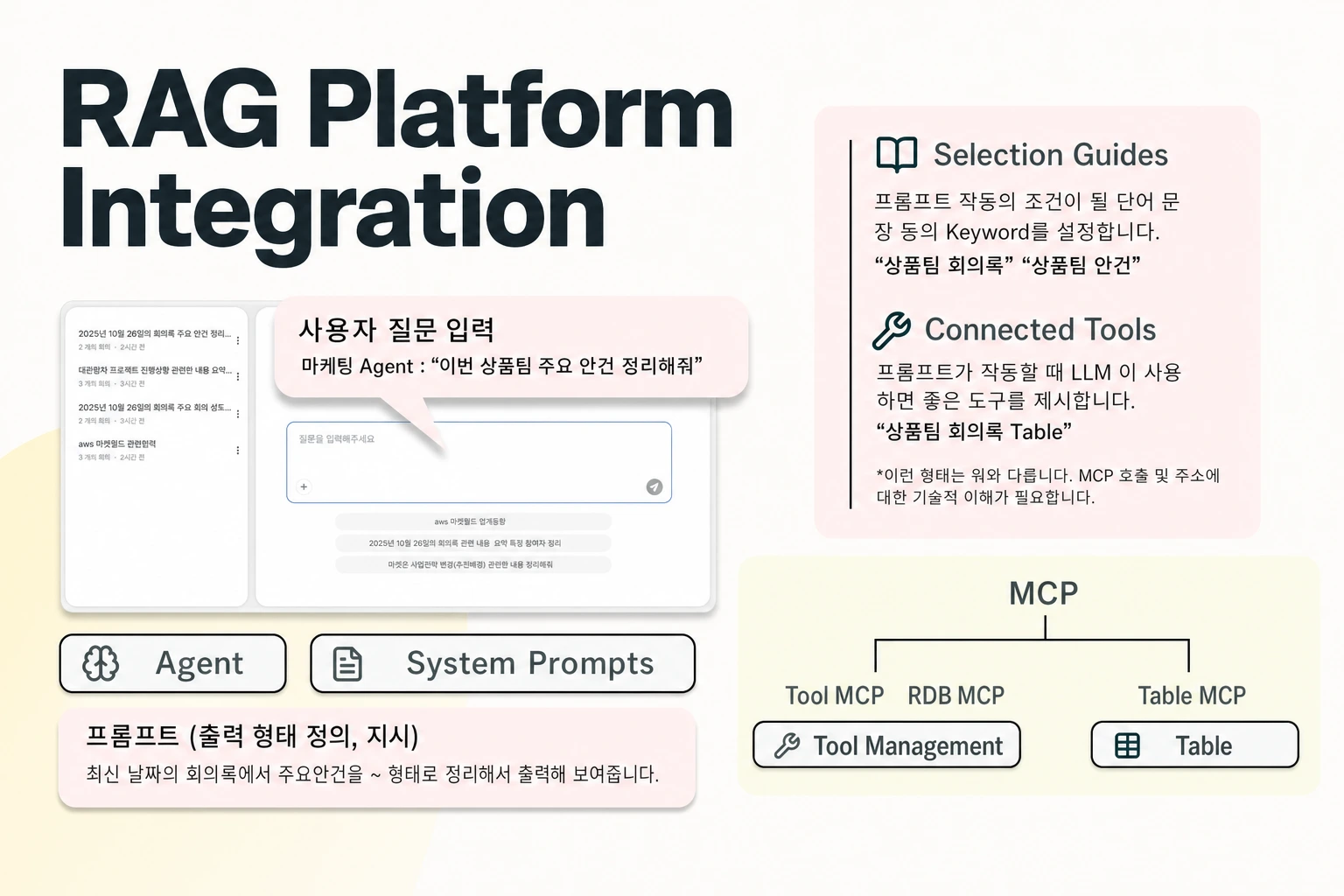
- Agent Ops covers agent creation and deployment, tool and system prompt connections, and access control, while Model Context Protocol (MCP) provides standard tool calling to external systems such as GitHub, Slack, PostgreSQL, and Atlassian.
- Seahorse Database operates as a container-based managed vector database with a built-in control plane, providing multi-tenant isolation, table and schema management, real-time monitoring, and API key authentication, while supporting NVMe optimization and VDPU acceleration.
- In the Agent Ops documentation, the Agent pages cover agent creation and deployment, while Tool Management covers external MCP tool registration.
- The custom tool creation documentation covers custom tools that support both Standard I/O (
stdio) and Streamable HTTP transports. - For operational auditing of connected tools, the tool detail documentation covers tool configuration, supported methods (tools), environment variables, call logs, and connected agents.
FAQS
FAQ
Which retrieval capabilities in Seahorse Cloud support high-recall compliance document searches?
Seahorse Storage allows you to raise the HNSW index parameters M (10–1024) and EF Construction (M to AS Size) at creation to increase index accuracy and quality, and combine Dense and Sparse embedding endpoints to run Hybrid mode (RRF) across semantic and keyword results. At query time, you can adjust Search Mode, Top K, EF Search, and RRF K without rebuilding the storage instance.
Can we change the embedding model or HNSW graph connections after creating a Seahorse Storage instance?
No, the embedding endpoints, vector dimension, M, and EF Construction are fixed when the Seahorse Storage instance is created. If you need to modify those foundational index settings, you must create a new Storage instance, whereas Search Mode, Top K, EF Search, and RRF K can be adjusted at search time.
Does automatic vector synchronization also update document access permissions?
The official product pages and manual do not describe permission propagation through vector synchronization, so test how source-document access changes are reflected in search results and agent access before production use.
Try it now
See how these criteria hold up on the real thing.