Structure-Aware RAG: What Native Semantic Chunking Covers
Seahorse Cloud integrates semantic chunking with document parsing, embedding, and vector sync. Structure-aware evaluation asks whether retrieved passages retain the headings, table context, and exceptions needed to answer a question.
Key Takeaway
- Adopt native semantic chunking: Seahorse AI-based storage includes semantic chunking inside a full-stack managed RAG platform.
- Separate integration from structure quality: Native chunking is part of the platform; heading, table, and exception context should be evaluated on your documents.
- Choose by workflow needs: Use an integrated ingestion path to reduce assembly work; consider custom components when you need direct control over specialized parsing and split rules.
Seahorse Cloud addresses retrieval-augmented generation (RAG) document ingestion by turning unstructured documents into AI-ready knowledge through autonomous parsing, semantic chunking, and a vector database.
Native Semantic Chunking in Storage
Native semantic chunking is built into Seahorse’s document ingestion workflow, reducing the separate components a team must connect. “Native” describes where the capability runs; it does not by itself specify how headings, tables, or section boundaries are preserved.
The three ingestion stages have different jobs. Parsing extracts text and layout from a file. Chunking groups or splits that extracted content into retrievable units. Embedding and indexing make those units searchable.
A Practical View of the Integrated Workflow
Semantic chunking aims to group related content into useful retrieval units. Structure-aware handling also considers document organization: keeping a heading with its paragraph or table values with their column headers can preserve meaning. Very long sections or tables may still need splitting. These are evaluation objectives, not a claim about Seahorse’s specific splitting algorithm.
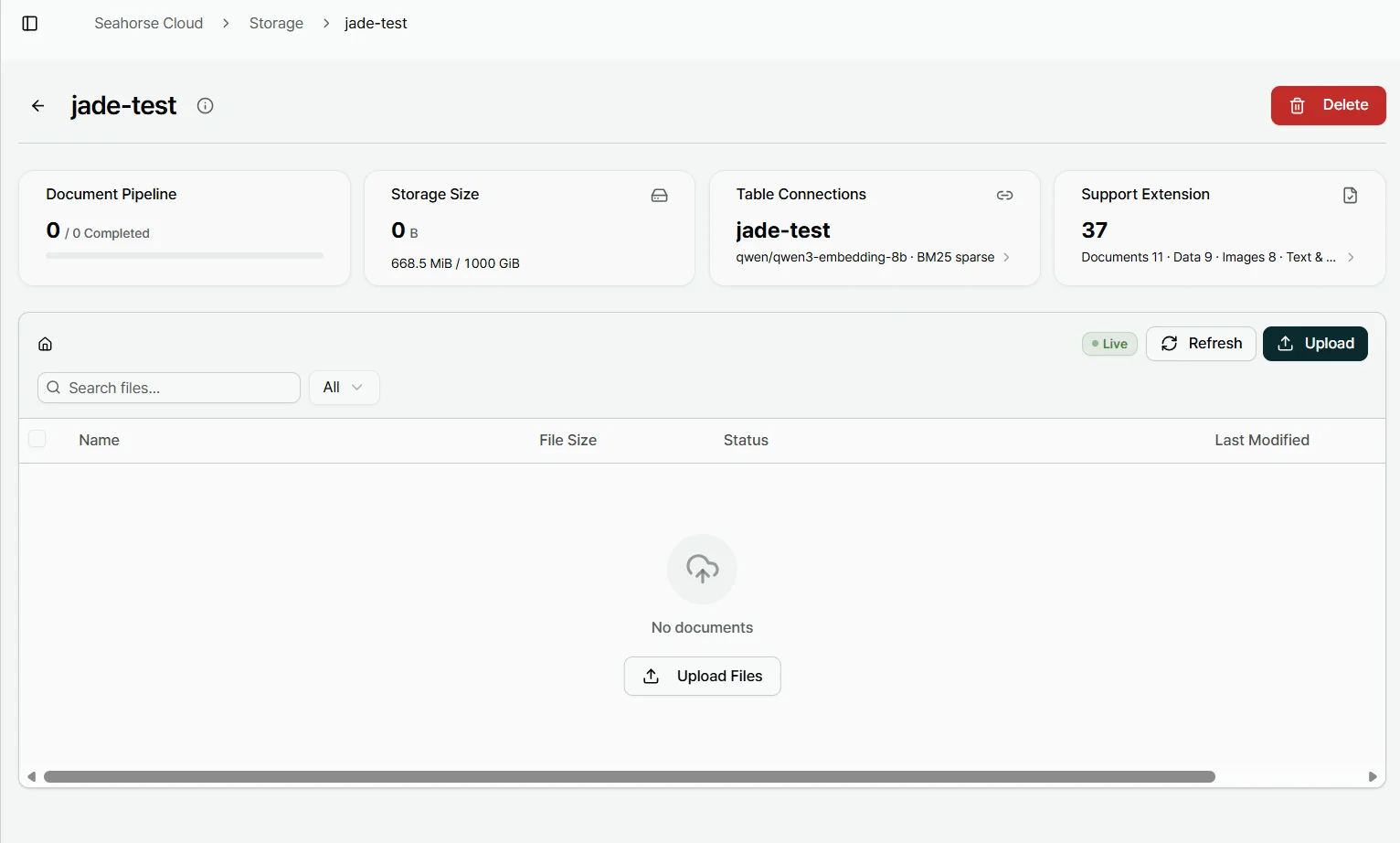
Seahorse Storage combines S3-compatible object storage, VLM/OCR/LLM-based document parsing, semantic chunking, embedding, and vector-database synchronization. Creating Storage also creates a dedicated Table; uploaded files then enter the processing pipeline. This integrated path fits teams that want fewer ingestion components to assemble. A Completed status means embedding has finished, not that every extracted value or chunk is correct.
Validate Structure with a Real Document
Once an installation manual is indexed, ask a question whose answer depends on a limit in a table and an exception in the next paragraph. A fixed-size split can separate the limit from its exception. Inspect whether the retrieved passages retain both pieces of context and a usable source location.
Operating a small evaluation requires three checks: inspect the structure and surrounding context in the chunks; ask representative questions about your documents; compare the retrieved evidence with the original source. Include a long table or section so the test covers content that cannot fit in a single chunk.
When the integrated workflow preserves the context your questions need, it can simplify document-to-retrieval operations. Teams that must control split rules or preserve specialized structures may prefer a custom parser and chunker alongside their existing retrieval stack.
FAQS
FAQ
Does native semantic chunking guarantee heading and table preservation?
The native feature label establishes that chunking is integrated into the platform. It does not specify every heading, table, or split rule. Evaluate those details using representative documents and inspect the retrieved passages alongside their source.
When does an integrated pipeline fit better than a custom parser and chunker?
An integrated pipeline fits teams that want uploads, parsing, embedding, and vector synchronization in one workflow. See the Seahorse Storage workflow. Custom components may fit better when an existing stack or specialized document format requires direct control over parsing and split rules.
Build your RAG pipeline
Set up Seahorse Storage to automate document parsing and vector sync.