How to Set Retrieval Accuracy Gates for an Enterprise RAG Rollout
Set retrieval gates with a representative, human-judged query set, risk-based thresholds for critical query groups, and regression checks before release. Keep retrieval quality separate from answer quality, and derive cutoffs from the task and baseline rather than assuming one universal score.

Key takeaways
- Test retrieval directly: Compare returned documents or passages with judged evidence.
- Set workload-specific gates: Pick metrics, cutoffs, and pass conditions to match the impact of a miss or an irrelevant result.
- Keep the test reproducible: Record the query set, labels, corpus and search configuration for each run.
- Retest changes: A passing result applies to the evaluated setup and conditions, not automatically to later changes or every production query.
A retrieval gate is a repeatable release decision: compare ranked evidence against human-labeled queries, set workload-specific pass conditions, and keep retrieval results distinct from the quality of generated answers. This guide covers building the test set, choosing thresholds, tuning Seahorse Cloud search controls, and recording release decisions.
What a retrieval accuracy gate should prove
A retrieval accuracy gate is a documented pass/fail rule for whether a proposed RAG configuration finds the evidence users need, at the ranks and result depth the application can use. Define the test set, relevance judgments, metric, cutoff, and risk limits before deciding whether a release passes. Microsoft’s RAG evaluator guidance says process evaluation assesses the quality of the document retrieval step. NIST says AI systems should be tested before deployment and regularly while in operation in its AI Risk Management Framework.
The gate should answer a narrow operational question: for the questions this system is expected to handle, does retrieval supply the right evidence to the answer stage? Save the ranked results for each query, not just an aggregate score. That lets reviewers inspect whether an evidence miss came from the retriever, whether the correct passage was returned too low, or whether irrelevant items crowded the useful context. When a RAG response is also scored, keep that result in a separate column: Microsoft’s RAG evaluator documentation describes process evaluation as assessing the quality of the document retrieval step and system evaluation as examining the quality of the final response in your RAG workflow.
Set thresholds for the task and the consequences of error. The BEIR study notes that real-world retrieval tasks can be precision- or recall-focused and that a model’s in-domain performance does not necessarily predict how it generalizes to other data. Use those findings as a reason to test your own corpus and questions, not as a score target for your deployment. A release decision becomes meaningful when the organization has stated what counts as relevant evidence, how results will be scored, which query groups carry higher risk, and who can approve or stop a release.
Build a representative, judged query set
A useful test set reflects the queries, sources, and operating conditions the production system is meant to serve. Start from real or carefully reviewed user questions, then group them by task and risk so an aggregate score cannot conceal a weak critical case. Include common lookups, exact names or identifiers, paraphrases, questions needing evidence from more than one document, version-sensitive questions, and queries for which the corpus has no supported answer when those patterns occur in the intended workload. These are test-design recommendations, not a claim that any fixed checklist or sample size is sufficient for every enterprise.
For each answerable query, record the expected relevant document or passage identifiers and the rationale for the label. Decide whether relevance is binary (relevant/not relevant) or graded, define the retrieval unit (document or chunk), and record how duplicate or overlapping chunks are treated. If the label set is incomplete, state that limitation: a metric based on known relevant items cannot establish that every relevant item in the corpus has been found. Microsoft’s document-retrieval evaluation documentation describes comparing retrieved documents with query-relevance ground-truth labels, while the BEIR benchmark paper documents retrieval evaluation across nine tasks: fact checking, citation prediction, duplicate question retrieval, argument retrieval, news retrieval, question answering, tweet retrieval, bio-medical IR, and entity retrieval.
Keep the evaluation record usable across runs. Give each query a stable ID and preserve its text, relevant evidence IDs, relevance grade if used, task category, risk tier, and any applicable user or access context. Record the corpus snapshot or document versions, query-time settings, result cutoff, and date of the run. The NIST AI RMF calls for documenting test sets, metrics, and evaluation tools, and for demonstrating performance under conditions similar to deployment. That makes test provenance part of the gate, not administrative overhead.
Separate examples used to tune retrieval from a held-back set used for the release decision. Use the held-back set only after the configuration and scoring rules are fixed; if the team later uses those cases for tuning, refresh the holdout before treating it as an independent release check.
Choose metrics and thresholds for the workload
Choose the metric by asking what a retrieval failure costs. Recall@k measures how much of the labeled relevant evidence appears in the first k results; prioritize it when missing a required source can make the answer incomplete. Precision@k measures how much of those first k results is relevant; it matters when irrelevant context can distract the answer stage or consume a limited context window. nDCG@k is useful when labels distinguish degrees of relevance and position matters, because it rewards a ranking that places more useful items higher. Microsoft’s RAG retrieval guidance defines Precision@K and Recall@K, and the BEIR paper describes nDCG@k as suitable for binary and graded relevance judgments.
Set k to match the result depth the application actually uses. State whether evaluation is over unique documents or chunks, and apply the same duplicate policy to every configuration. Report per-query results and slices by task or risk, as well as the aggregate; show the denominator so a small critical group is not hidden by a large volume of routine questions.
Derive the pass condition from a baseline and the consequences of error. First measure the current or simplest viable configuration on the frozen evaluation set. Then set a required floor for each critical query group, an overall target, and an allowed regression rule before comparing the candidate. Set the threshold as an organizational decision informed by workload risk. NIST says to document test sets, metrics, and the tools used for testing, and to measure and document performance or assurance criteria under conditions similar to deployment in its Measure guidance. If the test is small or labels are uncertain, report that uncertainty and inspect failures instead of treating a close score difference as conclusive.
Tune Seahorse Cloud without confusing settings for guarantees
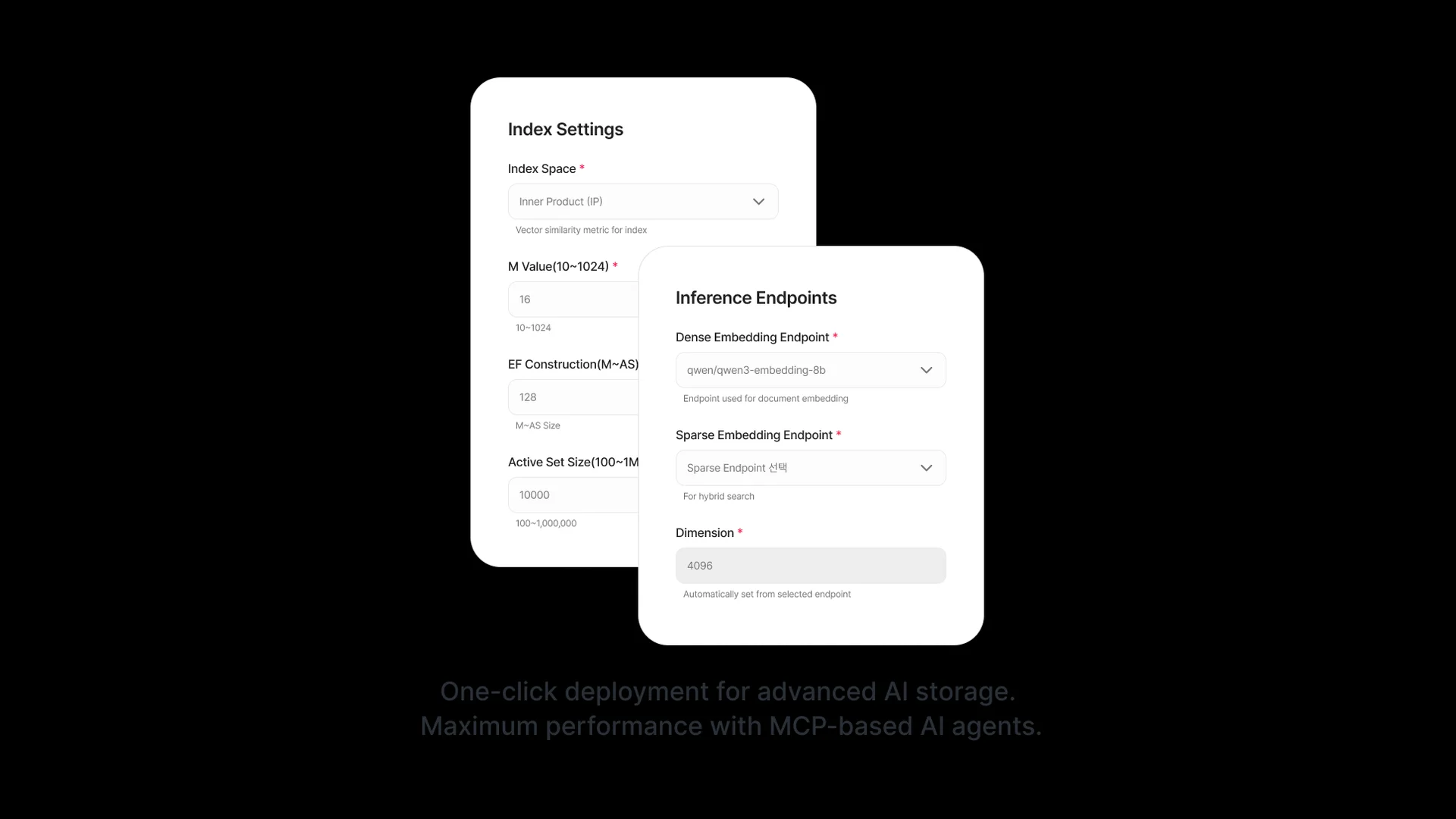
Seahorse Cloud’s Semantic Search documentation describes three search modes—Hybrid, Dense, and Sparse—and adjustable query-time controls including Top K and EF Search. The Semantic Search guide says Top K sets the maximum number of returned results; it is available in Hybrid, Dense, and Sparse modes. The guide lists EF Search as an HNSW query parameter for Hybrid and Dense modes, where higher values can improve search quality while slowing search. Treat these controls as configuration variables to test against your judged queries, not as accuracy scores or release criteria.
A controlled comparison changes one relevant setting at a time while keeping the query set, corpus, labels, and result depth consistent. For example, compare the production-intended mode with an alternative only on query groups where the difference matters, then inspect the ranked evidence and record both retrieval quality and latency. Do not infer that a setting will improve your workload simply because its documented direction sounds favorable: the measured result on your data is the decision evidence. If the application uses several settings together, record the entire configuration as a single versioned run.
Some Storage choices are made earlier in the workflow. The Storage creation guide says the Storage, table, and index are created together and that creation settings cannot be edited afterward. Plan comparisons accordingly: preserve the Storage and index details used in each run, and do not assume that changing a query-time control changes a creation-time setting.
The Dnotitia Seahorse Cloud product overview describes a RAG pipeline platform with AI model hosting, no-code pipeline design, and automated optimization. The product page and console guides cited here do not establish that Seahorse Cloud provides a built-in judged-query evaluation set, retrieval-accuracy scorecard, or automatic pass/fail rollout gate. Therefore, define and operate the acceptance test separately; the documented search controls are knobs to evaluate, not evidence that a configuration has passed your organization’s quality bar.
Run the release check and keep it current
A release gate is useful only if another team member can reproduce the decision. Before a production rollout, freeze the corpus snapshot, test queries and labels, search configuration, retrieval cutoff, metric definitions, and per-slice pass conditions. Run the candidate on the held-back evaluation set, save ranked document or chunk IDs for every query, compute the agreed metrics, and review failures in the high-risk groups individually. Microsoft’s document-retrieval evaluation guidance describes comparing retrieved documents with relevance ground truth and using retrieval metrics to debug or optimize search parameters; the NIST AI RMF calls for tests before deployment, documented methods, and ongoing monitoring in production.
Use a decision record that answers: which configuration was tested; what data and labels were used; which metric and cutoff governed the decision; whether each critical slice passed; what failure cases remain; who accepted the residual risk; and what would trigger a new evaluation. A release should fail when a pre-agreed hard condition fails, even if a strong overall average hides it. If the candidate misses a gate, investigate the query-level results, make a bounded change, and rerun the same evaluation. Keep any tuning set separate from the held-back set used for the final comparison.
Repeat the check when a material retrieval input changes—for example, the document corpus, embedding or indexing configuration, search mode, retrieval depth, or another component that changes the returned evidence. Then compare results against the last accepted baseline, not just against a remembered aggregate. After rollout, use representative production feedback to identify new failure types and refresh the evaluation set under a documented process; do not silently replace difficult cases with easier ones. NIST’s Measure function specifically calls for documenting test sets and metrics, demonstrating performance under conditions similar to deployment, and monitoring system behavior in production. The gate remains an organizational release control; the sources cited here do not establish that Seahorse Cloud automatically blocks releases based on these tests.
When production feedback reveals a new failure type, add it as a regression case after agreeing on its expected evidence and risk tier. Retain prior cases so coverage of the earlier workload remains visible alongside the new case.
Frequently asked questions
Is there one retrieval metric every enterprise RAG system should use?
No. Choose by failure cost and what the application consumes. Recall@k emphasizes whether labeled relevant evidence appears in the first k results; Precision@k emphasizes how much of that result set is relevant; nDCG@k can account for graded relevance and ranking order. The Microsoft RAG retrieval guide defines precision and recall at k, while the BEIR paper explains the role of nDCG for binary and graded relevance judgments. Record the cutoff and relevance unit so teams do not compare unlike scores.
Why evaluate retrieval and the generated response separately?
Evaluate retrieval and the generated response as separate steps. Microsoft’s RAG evaluator documentation describes process evaluation as assessing the quality of document retrieval and system evaluation as examining the quality of the final response.
Does Seahorse Cloud provide a built-in retrieval accuracy gate?
The official product and console sources cited here document search modes and settings such as Top K and EF Search, but they do not establish that Seahorse Cloud provides a built-in judged-query scorecard or automatic rollout pass/fail gate. Treat those settings as inputs to your own controlled evaluation, and do not infer that a setting or mode guarantees a result. See the Semantic Search guide and Dnotitia’s Seahorse Cloud overview.
지금 체험
See how these criteria hold up on the real thing.