Managed Vector Search SLAs: 3 Supplier Types Compared
Compare hyperscalers, specialist database vendors, and managed operators by SLA coverage, eligibility, and remedy, with Seahorse as an integrated RAG option.
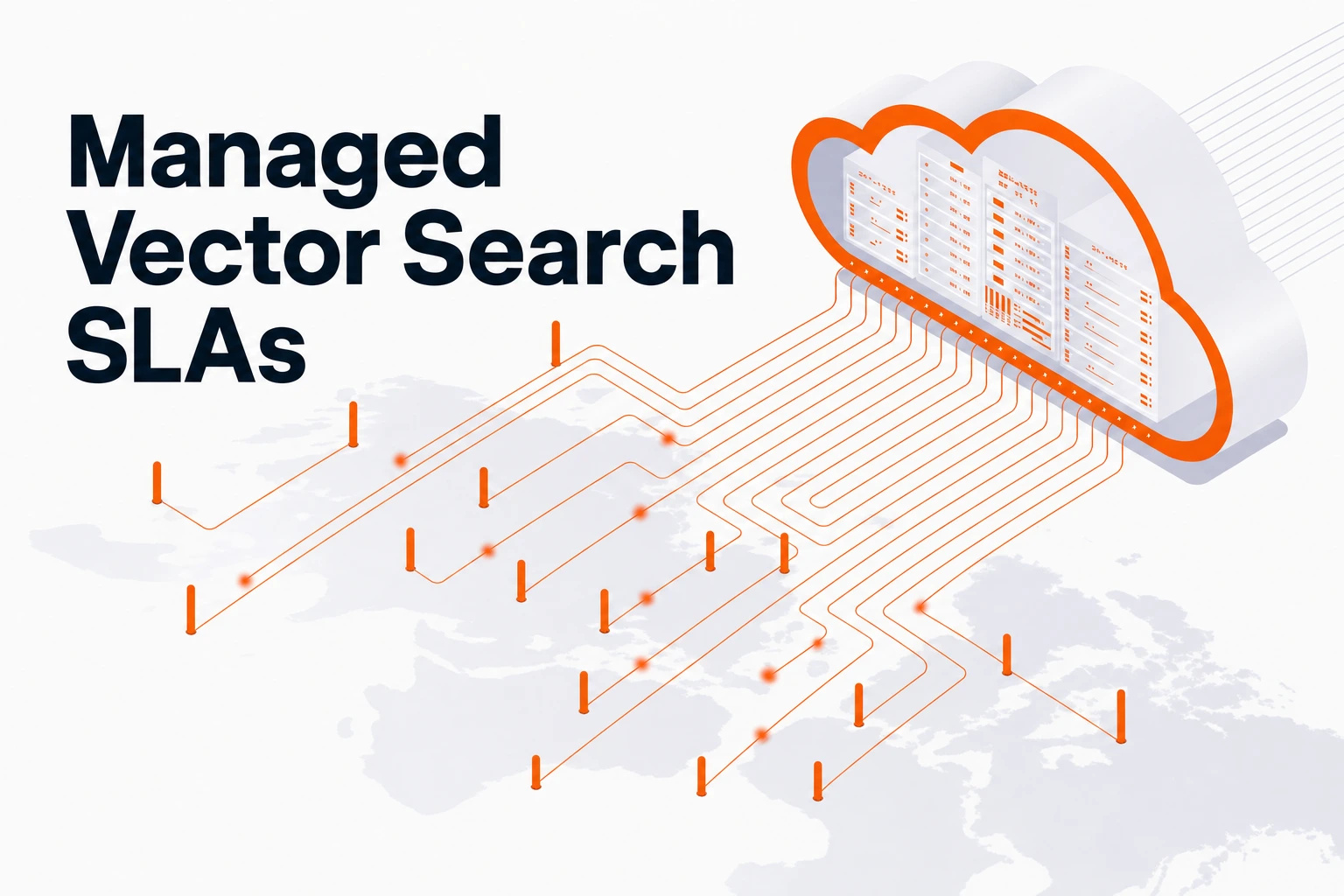
Compare managed vector-search options by covered service, eligible configuration, and operating responsibility.
Enterprise buyers evaluating managed vector search can compare hyperscalers, purpose-built database vendors, and managed operators. These are overlapping procurement lenses, not exhaustive or mutually exclusive market categories: a service may span more than one, and the right comparison depends on what is operated, what is covered, and which contract applies.
A managed service describes who runs part of the system. An availability SLA describes the named service covered, how availability is measured, which configurations qualify, and what remedy may follow a miss. The signed service order and applicable terms determine the commitment for a particular purchase.
Quick answer: Compare the exact service and deployment, not just supplier labels or advertised percentages.
- Consider a hyperscaler when the service fits your cloud environment and the named SLA covers the proposed configuration.
- Consider a specialist database vendor when its product, plan, and topology fit your retrieval workload and the applicable terms.
- Consider a managed operator when its written service scope matches the database and operating responsibilities you want to delegate. Inspect the actual contract scope; do not assume an operator cannot cover a broader application service.
- Consider Seahorse Cloud as an integrated RAG option when storage, document parsing, vector search, and agents are relevant together. Integration effort and any operational savings depend on compatibility with your existing stack, migration needs, and customization.
What makes a managed vector-search service contractually guaranteed?
A product feature page, a status page, and an SLA answer different questions. Product documentation describes capabilities or configuration. A status page reports service health. A legal SLA defines contractual coverage, eligibility, measurement, exclusions, and remedies. Even a public SLA does not by itself verify the terms in a particular customer's signed order.
The U.S. Government Accountability Office's 2024 cloud-procurement review found that six of 24 agencies had guidance ensuring four elements of an adequate SLA for vendor-deployed cloud services. That finding concerns agency procurement guidance; it is not a measure of vector-search performance or industry-wide SLA compliance. GAO's cloud procurement review provides that procurement context.
For each proposal, identify the product and component, plan, region or project, hosting and deployment type, and index or cluster topology. Then record the metric: for example, successful requests, endpoint reachability, or cluster availability. A configuration that works for a pilot may not qualify under the relevant SLA.
Keep availability separate from other service objectives. Record support response time, restoration or recovery time objective (RTO), recovery point or data-loss objective (RPO), and query latency as distinct fields. Do not infer one from another: an availability percentage, a response commitment, a restoration target, a recovery-point target, and a latency objective describe different things.
Exclusions may cover customer systems, planned maintenance, quotas, third-party dependencies, or use outside a defined normal operating range. Remedies may be capped future service credits with a claim deadline or other conditions. Compare the terms with the failures and recovery process that matter to your application, not only the largest published uptime figure.
Which supplier type fits your cloud and operations model?
These supplier types are useful comparison lenses, not mutually exclusive categories. The same procurement may combine a cloud platform, a database product, and an operator. Focus the shortlist on the service boundary, the parties' responsibilities, and the contract that applies to each component.
| Procurement lens | Candidates covered here | When to evaluate | Evidence type and contract focus |
|---|---|---|---|
| Hyperscale cloud provider | Google Vector Search on Gemini Enterprise Agent Platform, formerly Vertex AI Vector Search | The service fits an existing cloud environment and the proposed configuration can meet the SLA conditions | Public legal SLA: 99.9% monthly for an eligible index with at least two replicas and adequate provisioning; confirm the purchased service and configuration |
| Purpose-built vector database vendor | Pinecone, Qdrant Cloud, and Weaviate Cloud | A dedicated managed database and its plan or topology fit the retrieval workload | Pinecone legal addendum: 99.95% monthly subject to eligibility. Qdrant product documentation lists tier and topology targets; confirm the measurement period and contractual terms. Weaviate legal SLA lists quarterly targets and a separate credit schedule |
| Managed open-source operator | Dattell Managed OpenSearch | The team wants an operator to take on specific OpenSearch cluster responsibilities | OpenSearch provider-profile claim: 99.99% uptime SLA and response times of 15 minutes or less. Period and coverage of a purchased service must be confirmed in its SLA and order |
Integrated-platform comparison: Seahorse Cloud combines storage, document processing, vector search, and agents. Its product page describes platform components and delivery options, not a numerical availability commitment; request and review the applicable SLA and order.
A hyperscaler may fit an existing cloud operating model. A specialist may fit a team seeking a dedicated vector-database service. An operator may fit when its actual service scope takes on the management tasks the buyer wants to delegate. These options can overlap; compare the named components and agreements rather than treating the categories as a market-wide taxonomy.
When should you evaluate a cloud provider's managed vector search?
Evaluate a cloud provider when its service fits the existing architecture and the production configuration can satisfy the relevant SLA. Check network exposure, identity integration, region, quotas, expected query patterns, and the vector service's role in the application. The service named in the order, the architecture diagram, and the SLA's covered-service definition should refer to the same component.
Google Vector Search
Google's public SLA names the covered product “Vector Search on Gemini Enterprise Agent Platform (formerly Vertex AI Vector Search)” and states a 99.9% Monthly Uptime Percentage for an index deployed with at least two replicas. The measurement period is monthly, measured per project and region, subject to the SLA's conditions. Google's Vector Search SLA is the legal SLA source.
Google defines Error Rate using valid requests that return HTTP 5XX with the code “Internal Error” divided by all valid requests, with at least 2,000 valid requests in the measurement period. It defines downtime as an error rate above 5%; a downtime period must last at least ten consecutive minutes. The SLA also lists exclusions, including specified customer or third-party causes, factors outside Google's reasonable control, agreement-violating behavior, and documented or system quotas.
The deployment guidance says an index needs minReplicaCount of at least 2 and adequate provisioning for workload size; fewer than two replicas per shard are excluded from SLA coverage. Include replica count and provisioned capacity in the design review. Google's VPC deployment guidance describes these deployment conditions.
The SLA's credit process has two separate timing requirements: notify Google support within 30 days after becoming eligible for a credit and provide downtime logs. Approved credits are applied within 60 days after the credit is requested. The SLA caps credits for all downtime periods in one billing month at 50% of the amount due for the covered service in the affected region. Verify the applicable terms and claim mechanics for the purchased service.
What distinguishes purpose-built vector database vendors?
Purpose-built vendors make the vector database a central product decision rather than one capability within a broader cloud service. Compare the paid plan, deployment, topology, measurement period, exclusions, and remedy for the exact offer.
Pinecone
Pinecone's Database Service Level Addendum is a legal SLA document. It applies to Database Services under a qualifying Enterprise Advance Commitment and must form part of the applicable agreement. It states 99.95% availability in each calendar month, excluding the listed exceptions.
The addendum calculates monthly uptime from downtime and total minutes in the month. Exceptions include stated customer-system or connection issues, cloud-provider failures, force majeure, authorized suspension of end-user access, and maintenance with advance notice. Service-level credits are the sole and exclusive remedy under the addendum, apply to future Database Services charges, have no cash value, and generally expire with the applicable order. Confirm eligibility and the addendum's inclusion in the customer's agreement; the public document alone does not verify an individual purchase.
Qdrant Cloud
Qdrant's Cloud Premium documentation lists uptime targets of 99.5% for Standard, 99.9% for Premium, and 99.95% for Premium Multi-AZ clusters. These are product-documentation claims; confirm the measurement period, detailed SLA definitions, and purchased coverage in the applicable SLA and order.
Qdrant states that Multi-AZ is independent of replication factor. Specify the requested tier and zone topology explicitly rather than treating a replica setting as proof of zone distribution. Confirm that the proposed configuration is available and included in the offer.
Weaviate Cloud
Weaviate's Service Level Agreement defines availability in relation to service functionality and accessibility and applies its commitment to “Normal Use.” It excludes certain issues caused by application errors, misuse, or misconfiguration. The measurement period is quarterly for the listed subscription targets.
For subscriptions beginning October 27, 2025 or later, the SLA lists quarterly targets of 99.5% for Flex, 99.9% for Premium shared, and 99.95% for Premium dedicated. The remedy table provides no credit at availability of 99.9% or above, including for Premium dedicated. This creates a target/remedy gap for the dedicated tier: ask Weaviate to clarify in writing how the 99.95% target relates to the credit schedule.
The credit schedule varies by plan and availability band, reaches up to 30% of monthly fees, and requires an email claim within 30 days. Its intermediate bands use strict “less than” and “more than” cutoffs. Request written clarification of exact-threshold outcomes rather than assuming how a boundary is treated. Align expected request volumes, query and ingestion patterns, peak periods, and configuration assumptions with the SLA's Normal Use definition.
When is a managed OpenSearch operator the right choice?
An operator can be relevant when a platform team wants OpenSearch vector-search capabilities and plans to delegate specific cluster management, monitoring, or optimization tasks. OpenSearch documentation describes storing and searching vector embeddings alongside existing data for semantic search and RAG. The operator's contract and any underlying hosting-provider terms may cover different components; inspect the actual scope rather than assuming the operator cannot cover a broader application service.
The OpenSearch project's Dattell provider profile describes cluster management, monitoring, and optimization across AWS, Azure, Google Cloud, or on-premises environments. The profile states a 99.99% uptime SLA and response times of 15 minutes or less. These are provider-profile claims, not verification of the SLA in a specific purchased order. The profile does not establish the measurement period or prove the purchased service's covered scope; confirm both in the applicable SLA and order.
A response-time commitment is not a restoration or resolution commitment. Ask for separate written terms for availability, incident acknowledgement or response, restoration target (RTO), recovery point or data-loss target (RPO), and query latency. Map who manages the database, network, identity, and application components, and which party owns escalation for each failure mode.
How does an integrated managed-RAG platform fit?
Seahorse Cloud is an integrated managed-RAG option for buyers comparing a standalone vector-search service with a broader document-to-agent platform. Its product page describes object-storage management, a vector database, document parsers, and managed agents. It also lists S3-compatible object storage, automatic vector-database synchronization, semantic chunking, and autonomous document parsing.
The page describes a container-based vector database with a built-in control plane for schema management and monitoring, and managed agents built on vector database and RAG with MCP-standard tool-calling support. Whether integration reduces effort depends on compatibility with the buyer's existing stack, migration requirements, and customization; do not assume savings without evaluating those factors.
The product page lists on-premise installation and SaaS subscription. It does not establish a numerical availability commitment. Request the applicable SLA and order, and verify the covered service, measurement period, eligibility, exclusions, support terms, and remedy before treating availability as contractually committed.
How can you compare availability guarantees on the same terms?
The table separates a stated target or product fact from its measurement period and the kind of source that supports it. It does not verify that any particular customer's order incorporates the public terms or profile claims.
| Candidate | Published target or service fact | Measurement period | Evidence type and eligibility / measurement | Remedy or coverage status |
|---|---|---|---|---|
| Google Vector Search | 99.9% monthly uptime for an eligible index | Monthly; per project and region | Public legal SLA; index requires at least two replicas and adequate provisioning; request-error and downtime thresholds apply | Future-use credits; monthly aggregate capped at 50% of the affected regional service amount. Support notice within 30 days after eligibility and downtime logs required; approved credits applied within 60 days after request |
| Pinecone Database Services | 99.95% availability | Each calendar month | Public legal addendum; qualifying Enterprise Advance Commitment and inclusion in the applicable agreement required; listed exceptions apply | Future Database Services credits are the exclusive remedy, have no cash value, and generally expire with the applicable order |
| Qdrant Cloud | Standard 99.5%; Premium 99.9%; Premium Multi-AZ 99.95% | Confirm in applicable SLA | Product documentation lists tier and topology targets; Multi-AZ is independent of replication factor | Confirm detailed definitions, remedy, and purchased coverage in the applicable SLA and order |
| Weaviate Cloud | For subscriptions beginning October 27, 2025 or later: Flex 99.5%; Premium shared 99.9%; Premium dedicated 99.95% | Quarterly | Public legal SLA; Normal Use applies and certain application errors are excluded | No credit at 99.9% or above, including for Premium dedicated; credit bands reach up to 30% and have strict thresholds. Request written clarification of the target/remedy gap and exact cutoffs |
| Dattell Managed OpenSearch | Provider profile states 99.99% uptime SLA and response times of 15 minutes or less | Confirm in applicable SLA | OpenSearch provider-profile claim; profile describes management across several hosting options but does not verify a purchased SLA | Confirm covered service, metric, response terms, RTO/RPO, and remedy in the written SLA and order |
| Seahorse Cloud | Product page describes integrated managed-RAG scope; no numerical availability commitment verified from this cited page | Not stated on cited product page | Product-page evidence lists platform components and on-premise or SaaS options | Request the applicable SLA and order; numerical coverage and remedy are not verified from the product page |
Procurement record
Capture these fields for every proposal so unlike commitments are not compared as if they were interchangeable:
- Covered service and source type: Name the component, product edition, and SKU. Label the evidence as a legal SLA, product documentation, provider-profile statement, product-page description, or signed-order term.
- Eligibility and architecture: Record account or project, region, endpoint, plan, replica and zone layout, capacity, and request assumptions. Attach the architecture that shows any required topology.
- Availability measurement period and metric: Record the period separately from the percentage, plus the numerator and denominator, valid-request definition, minimum request volume, outage threshold, and reset or aggregation method.
- Support response: Record acknowledgement or response time, support hours, severity definitions, and escalation path. Do not treat response time as restoration or resolution time.
- Restoration and recovery: Record any restoration target or RTO, recovery point or RPO/data-loss target, and dependency on customer action. Leave values unconfirmed when the applicable terms do not specify them.
- Query latency: Record the measured operation, percentile, workload, and conditions only when the proposal defines them. Do not infer latency from an availability commitment.
- Exclusions and responsibility: Record customer-network or configuration failures, quotas, maintenance, third-party dependencies, and force majeure, then assign an owner for each category.
- Claim mechanics and remedy: Capture deadline, required logs, contact route, credit basis and cap, expiry, and whether the remedy is exclusive. Separate operational incident reporting from a formal claim.
- Version and purchase evidence: Record the source version or URL, review date, product edition, signed order, and amendments. A public source or profile is not proof that a particular contract includes the same terms.
How should an enterprise choose and verify its shortlist?
- Choose the procurement lens from the operating model. Start with cloud footprint, data location, network design, and which database or RAG tasks the team wants to operate. Supplier categories can overlap; focus on responsibilities and contract boundaries.
- Name the production service and configuration. Record the exact product, plan, region, endpoint, and shared, dedicated, or multi-zone topology. For an operator, identify which party manages each layer and what the order includes.
- Match the written coverage to the architecture. Compare eligibility, measurement period, request or workload assumptions, exclusions, and topology requirements with the production design. Use the proposed bill of materials and architecture diagram.
- Compare distinct service objectives. Review availability, support response, restoration/RTO, recovery point/RPO, and query latency as separate terms. Do not fill a missing objective with an assumed value.
- Assess remedies against business impact. Record what can be claimed, the deadline, the evidence required, the cap, and who submits the claim. Keep service credits separate from application recovery objectives.
- Test the production-like workload. Exercise ingestion, index updates, retrieval, peak traffic, network paths, and failure handling. Measure application outcomes alongside the provider's availability metric.
- Retain and revisit the evidence. Keep the applicable SLA, signed order, product edition, topology, and approved exceptions. Recheck after a service rename, tier change, or renewal.
As an illustrative calculation only, in a hypothetical 30-day month with every minute measured equally and no special exclusions, 99.9% availability corresponds to 43.2 minutes below full availability; 99.95% corresponds to 21.6 minutes. This arithmetic is not a conversion of every supplier's contractual SLA: definitions, measurement periods, qualifying events, exclusions, and aggregation can differ.
The shortlist is defensible when the technical design matches the workload and the applicable contract clearly covers that design with a defined measurement, support process, and remedy. A higher percentage alone does not establish broader coverage.
Source review date: September 30, 2026. The entries distinguish public legal terms, documentation, provider-profile claims, and product-page facts. Public sources do not establish the terms of an individual customer’s agreement; confirm the applicable version and coverage before relying on a commitment.
FAQ
Does a managed vector database automatically come with an uptime SLA?
No. Managed operations and contractual SLA coverage are separate. Google and Pinecone publish legal SLA documents with eligibility conditions, while Qdrant's cited page is product documentation and Dattell's cited figure is a provider-profile claim. Verify the exact service and terms in the applicable agreement and order.
Is Google Vector Search covered if its index has one replica?
Google's public SLA requires at least two replicas for the covered index. Separately, its deployment guidance specifies adequate provisioning and says fewer than two replicas per shard are excluded. Confirm the proposed architecture against the current applicable terms.
Does Pinecone's 99.95% target apply to every plan?
No. The public Database Service Level Addendum applies to Database Services under a qualifying Enterprise Advance Commitment and must form part of the applicable agreement.
Which Qdrant Cloud configuration has the 99.95% published target?
The cited Cloud Premium documentation lists Premium Multi-AZ clusters at 99.95%. Confirm the measurement period and contractual coverage in the applicable SLA and order.
Does Weaviate's Premium dedicated target guarantee a credit below 99.95%?
The public SLA lists a 99.95% quarterly target for Premium dedicated, but its table provides no credit at availability of 99.9% or above. Ask Weaviate to clarify the target/remedy relationship and strict threshold boundaries in writing.
Does Dattell's 15-minute response statement mean service restoration within 15 minutes?
No. The provider profile states response times of 15 minutes or less; that is not a restoration or resolution target. Confirm separate response, RTO, RPO, and availability terms in the applicable written SLA and order.
Does Seahorse Cloud's product page establish a numerical availability SLA?
No numerical availability commitment is verified from the cited product page. Request the applicable SLA and order to confirm coverage, measurement, and remedy.
Should an integrated RAG platform be compared with vector databases?
Yes, when the purchase decision includes related storage, document processing, retrieval, or agent components. Compare actual compatibility, migration and customization effort, operating scope, and contract coverage rather than assuming integration will reduce effort.
Try Seahorse Cloud
Explore the platform in the Seahorse Cloud console.