
Evaluating MCP Tool Integration for Enterprise Agents
A strategic evaluation framework for enterprise AI agent tool integration, focusing on open MCP standards, tool authorization, delegated identity, lifecycle governance, and failure handling.
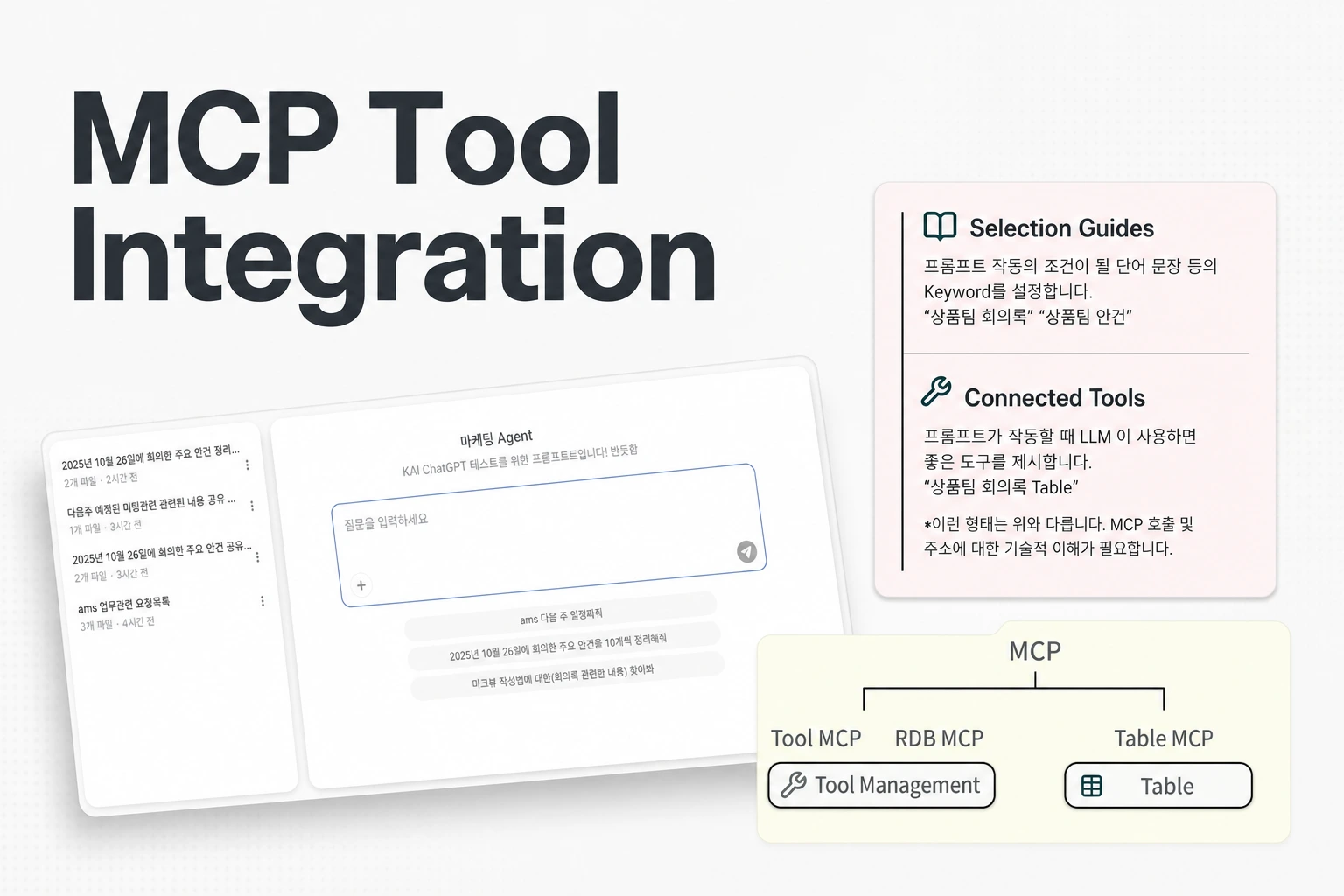
Key takeaways
- Explicit Protocol Baseline: Built on the MCP 2025-11-25 specification. Enterprise teams must verify negotiated client and server capability declarations in their specific environment.
- System Responsibilities & Tool Lifecycle: MCP standardizes message exchange for tool discovery (
tools/list) and invocation (tools/call), while host applications manage user authorization, session context, and transaction boundaries. - Credential Scoping & Transport Boundaries: API keys can support scoping, expiration, and rotation depending on implementation; security risks stem primarily from broad, long-lived, shared credentials. OAuth 2.1-based authorization applies to network Streamable HTTP transports, whereas local stdio transports depend on OS process isolation and explicit environment configurations.
- Categorizing Failures: Enterprise systems must distinguish transport/network failures, JSON-RPC protocol errors, and tool-level execution results with
isError: trueas defined in the MCP tools specification. - Idempotency & Timeout Governance: A network timeout does not confirm whether a backend action executed. Applications executing mutating actions should implement supported retry-safety mechanisms (such as deduplication keys, inherently idempotent operations, or transactional constraints) or reconciliation procedures to handle unresolved outcomes.
An MCP connection gives an agent a way to discover and call tools, but the surrounding application still needs access controls and reliable operations. This guide provides an evaluation framework for enterprise teams assessing Model Context Protocol (MCP) tool integration, focusing on protocol semantics, credential boundaries, error governance, and operational acceptance criteria.
Interface Architecture: System Responsibilities and Tool Lifecycle
Integrating enterprise AI agents with internal systems requires distinguishing transport formatting from capability discovery, execution governance, and backend business logic. Under the MCP 2025-11-25 transport specification, MCP utilizes JSON-RPC 2.0 to structure client-server communications.
Component Responsibilities and Security Enforcements
| System Component | Primary Responsibilities | Where Controls Must Be Enforced |
|---|---|---|
| Host Application / Agent Framework | User identity management, session handling, UI approval flows, prompt construction, and workflow orchestration. | Enforces user authentication, high-level policy rules, and human approval prompts. |
| MCP Client | Establishes transport sessions, negotiates capabilities during initialize, formats JSON-RPC payloads, and issues tools/list and tools/call. | Enforces request formatting, timeout handling, and transport retry limits. |
| MCP Server | Exposes tool definitions via tools/list, parses input schemas, routes invocation requests, and returns tool results or execution errors. | Enforces schema validation, token audience verification, and tool-level input sanitation. |
| Backend Service / Resource Server | Executes domain logic, performs database transactions, enforces row/table access controls, and logs persistent audit events. | Enforces fine-grained database ACLs, business authorization, and atomic idempotency. |
Tool Discovery and Execution Lifecycle
- Protocol Initialization (
initialize): Client and server exchange capability declarations (such as tool support or prompt templates) during connection setup as outlined in the MCP lifecycle specification. - Schema Exposition (
tools/list): The client requests available tool definitions. The server returns JSON Schema objects detailing parameter names, types, and descriptive metadata. - Execution Request (
tools/call): The agent client selects a tool and sends a JSON-RPC request containing the toolnameand structuredarguments. - Result / Error Returning: The server executes or proxies the request and returns content blocks. If execution or argument validation fails within the tool server, the response may include an optional boolean
isError: trueflag to inform the model reasoning loop.
Streamable HTTP vs. Local stdio Transport Boundaries
Protocol expectations and authorization models differ across transport bindings:
- Streamable HTTP Transports: Operates over HTTP networks where transport security, TLS, and OAuth 2.1-based token authorization apply when supported, as described in the MCP authorization specification.
- Local stdio Transports: Runs MCP servers as child processes communicating over standard input and output streams. stdio does not automatically sandbox process execution; security depends on explicit operating system permissions, local user boundaries, and restricted process environment variables.
Credential Management, Scoped Authorization, and Trust Boundaries
Enterprise tool authorization requires balancing agent autonomy with strict boundary enforcement.
API Keys and Credential Scoping
API keys are not inherently insecure. Their scoping, expiration, and rotation depend on implementation. Broad, long-lived, unscoped or shared credentials are important risk factors, particularly when they weaken individual attribution or permit unnecessary actions.
NIST security guidance recommends treating agents as distinct operational entities bound to user or system identities (NIST Cybersecurity Insights). Enterprise architecture must separate standard protocol rules from recommended buyer evaluation checks:
- Protocol Specification Rules: Under the MCP authorization specification, MCP servers supporting HTTP authorization must validate that incoming access tokens were specifically issued for that MCP server. Servers accessing downstream endpoints must use separately authorized downstream credentials rather than simply forwarding or transforming incoming client tokens.
- Recommended Buyer Evaluation Checks: Enterprise evaluators should verify that credential management supports dynamic scoping, automated expiration, token revocation across active sessions, and step-up authorization prompts for sensitive actions.
Schema Validity vs. Business Authorization
Syntactic schema validity does not establish semantic authorization. A tool call payload may satisfy JSON Schema rules perfectly (e.g., {"customer_id": "89012", "status": "inactive"}) while violating business authorization rules (for example, if the operating user lacks permission to modify customer 89012). Backend resource servers must enforce authorization checks during execution regardless of input schema compliance.
Error Governance, Untrusted Inputs, and Observability
Resilient agent deployments require clear failure categorization and secure logging practices.
Categorizing Failure Modes
Enterprise evaluators must distinguish three separate failure categories:
- Transport & Connectivity Failures: Network drops, socket disconnects, or client timeouts where no JSON-RPC response message is delivered. A network timeout confirms only that the response was not received within the deadline; it does not prove whether the backend action executed or failed.
- JSON-RPC Protocol Errors: Returned when the message is malformed, JSON parsing fails, or the requested method is unrecognized (e.g., JSON-RPC error code
-32601). These indicate platform or formatting failures where the request could not be processed by the protocol layer. - Tool Execution Errors (
isError: true): Returned within a valid JSON-RPC result when the tool endpoint successfully receives the request but execution fails due to input validation errors or business logic failures (e.g., record not found or API rejection). BecauseisError: truecan be returned during parameter pre-validation, its presence does not confirm that business logic was executed. Note also thatisErroris an optional field in the MCP tools specification.
Idempotency Keys, Status Checks, and Race Conditions
A JSON-RPC request ID correlates a request and response; it does not provide business transaction deduplication. Before retrying a mutating operation, verify a supported safety mechanism such as server-side deduplication, inherently idempotent semantics, or transactional constraints. Document its scope and retention. A status check alone can race with an in-flight action; pause or escalate when the outcome cannot be safely resolved.
Untrusted Inputs and Log Hygiene
- Untrusted Content Handling: Tool definitions, tool execution results, and retrieved content must be treated as untrusted inputs. Security policies enforced outside the model reasoning loop must govern execution, as input sanitization alone does not guarantee protection against indirect prompt injection.
- Log Hygiene: Audit records should capture correlation IDs, user/tenant identifiers, tool names, and authorization outcomes without logging raw secrets, API tokens, passwords, or internal model reasoning traces.
Quantitative Evaluation Model and Performance Metrics
Sizing agent tool overhead requires defined operational metrics and transparent workload accounting.
Hypothetical Tool Call Overhead Sizing
To illustrate how transient retry policies increase invocation volume, consider a hypothetical scenario:
- Base Workload: 100 autonomous tasks, with each task planning 3 tool invocations (300 base tool calls).
- Retry Volume: If 10% of tool calls experience transient network glitches requiring 1 retry, 30 additional tool calls are attempted (330 total tool call attempts).
- Volume Analysis: This scenario results in a 10% increase in tool call invocation count. Because total task costs depend on token usage, infrastructure runtime, and potential manual recovery labor, a 10% increase in tool call volume does not imply a linear 10% increase in total cost.
Industry Operational Context
In a public survey fielded from November 18 to December 2, 2025, receiving 1,340 responses (63% from the technology sector), 52.4% of respondents reported conducting offline evaluations and 62% reported implementing detailed tracing (LangChain State of Agent Engineering). This vendor-run, self-selected survey reflects early engineering adoption trends among practitioners, but it does not represent standardized industry performance benchmarks or proof of cost savings.
Core Evaluation Metrics
| Metric | Metric Definition | Operational Objective |
|---|---|---|
| Task Success Rate (%) | Percentage of initiated tasks achieving the correct, authorized business outcome against an evaluation rubric (including expected human approvals). Denominator: total initiated tasks. | Measures end-to-end task completion accuracy. |
| Denied Call Rate (%) | Ratio of attempted tool calls rejected due to authorization, audience, or policy checks out of total tool call attempts. Denominator: total attempted tool calls. | Provides diagnostic context; the rate alone does not establish authorization effectiveness. |
| Execution Latency (p50 / p95) | Median and 95th-percentile response time for tools/call invocations. | Evaluates endpoint responsiveness and system latency. |
| Retry / Re-invocation Rate | Percentage of tool invocations requiring re-execution due to transport or tool errors. | Assesses endpoint stability and network resilience. |
| Manual Recovery Labor | Staff-hours required to investigate and manually reconcile failed or ambiguous mutating tool calls. | Quantifies human operational support overhead. |
| Cost per Successful Task | All model and tool charges, including failed attempts and retries, plus allocated runtime, storage, observability and recovery labor for the period, divided by tasks meeting the success rubric. State included costs; the ratio is undefined if no task succeeds. | Tracks task unit economics under specific operational scope. |
Enterprise Integration Acceptance Worksheet
Use this worksheet to test candidate agent platforms against operational failure scenarios and security boundaries. These are proposed acceptance goals for tested scenarios, not universal MCP guarantees or measured platform results.
| Evaluation Test Scenario | Expected System Behavior | Verification Goal / Metric |
|---|---|---|
| 1. Denied / Wrong-Audience Credential | Server rejects tokens lacking required audience claims; invocation is blocked before tool execution. | For HTTP authorization adopters: invalid tokens receive HTTP 401; insufficient scope is typically HTTP 403. Verify that the protected business action was not executed; authorization checks may themselves query a database. |
| 2. Expired Credential Handling | Token expiration triggers re-authentication or authorized token refresh; no action continues under expired credentials. | Structured validation error logged; re-authentication initiated cleanly. |
| 3. Token Revocation Propagation | Revocation blocks subsequent access within a buyer-defined target window, including paths using cached credentials or results. | Measure elapsed time from revocation to denial; verify cached paths and separately reconcile in-flight committed writes. |
| 4. Cross-Tenant / User Isolation | Unauthorized session A cannot inspect tools, execute actions, or access memory belonging to user/tenant B. | Zero unauthorized cross-tenant context access observed in test scenario. |
| 5. Malicious Tool Output / Injection | Tool result containing prompt injection instructions is governed by external security policies outside the LLM. | Task executes according to policy without unauthorized disclosure in test scenario. |
| 6. Schema / Tool Version Drift | Tool schema updates on server; client detects mismatch or re-lists tools via tools/list without crashing. | Structured validation error or clean schema re-synchronization recorded. |
| 7. Timeout on Mutating Action | Reconcile the operation status; retry only under the same server-enforced idempotency contract, or escalate an unknown outcome for manual review. A status query alone cannot prevent duplicate writes. | Single backend record update verified; duplicate write prevented in test scenario. |
| 8. Atomic Deduplication with Idempotency Key | Where a server-enforced idempotency-key contract is supported, replay within its scope and retention window and verify duplicate-effect prevention; response replay behavior depends on the implementation. | Within documented retention, identical actor/tenant, operation, payload and key produce no duplicate effect; a changed payload reusing the key is rejected. |
| 9. Bound Human Approval (HITL) | High-risk action (e.g., CRM status change) binds approval to exact tool, normalized arguments, actor, tenant, expiry, and operation ID. | Argument modification or replay attempt fails; approval logged with operation ID. |
| 10. Rate Limits & Bounded Backoff | Handle rate limits with bounded, retry-safe behavior according to policy; backoff and jitter are common strategies. | Verify retry limits and timing against policy; a circuit breaker is one optional control. |
| 11. Audit Logging & Secrets Redaction | System logs structured event with correlation ID, tenant ID, and tool name; API keys/passwords redacted. | Audit entry contains required metadata; zero plain-text tokens in logs. |
Managed Agent Infrastructure with Seahorse Cloud
Moving from experimental agent scripts to production infrastructure requires managing retrieval pipelines, agent execution, and protocol compliance across enterprise environments.
Seahorse Cloud provides a managed AI storage and agent platform combining object storage, document parsing, vector database synchronization, and managed agents, supporting SaaS and on-premises deployments (Seahorse product page).
Managed agents support Model Context Protocol tool execution, inference APIs, and usage tracking, alongside cross-session context memory (Seahorse homepage).
Enterprise evaluation teams should distinguish published platform capabilities from specific downstream governance controls:
- Published Platform Features: Support for MCP tool calls, document parsing, vector database synchronization, inference APIs, and cross-session context memory.
- Buyer Verification Requirements: Organizations evaluating Seahorse Cloud or similar managed platforms must independently verify downstream database ACL enforcement, custom MCP server tenant isolation, log retention compliance, and specific enterprise SSO/OIDC integration policies.
- RAG Retrieval vs. Live Tool Execution: Document ingestion pipelines and live agent tool execution represent distinct operational workflows; neither function is universally dependent on automated object-store or vector-database synchronization.
FAQ
How does the Model Context Protocol standardize agent tool interactions across systems?
MCP establishes open JSON-RPC message structures for tool discovery (tools/list) and tool execution (tools/call), decoupling agent reasoning loops from proprietary connector interfaces as specified in the MCP 2025-11-25 specification.
How do local stdio transports differ from Streamable HTTP transports regarding authorization?
Local stdio transports launch child processes; OS permissions and environment credentials require explicit configuration. When HTTP authorization is supported, Streamable HTTP integrations use the OAuth 2.1-based flow and token audience validation described in the MCP authorization specification.
What is the difference between a JSON-RPC protocol error and a tool result with isError: true?
JSON-RPC protocol errors indicate that the request message was malformed, unparseable, or directed to an invalid method code. A tool result with isError: true means the request was successfully received by the MCP server, but execution or input validation failed within the tool endpoint (e.g., argument validation error or database lock), returning details to the model under the MCP tools specification.
Does a JSON-RPC request id guarantee business idempotency during retries?
No. A JSON-RPC ID correlates requests and responses, not business effects. Use a supported retry-safety contract, such as deduplication keys, inherently idempotent operations, or transactional constraints. A status check alone may race with an in-flight action. Reconcile the outcome and pause or escalate when safe retry cannot be established.
What capabilities does Seahorse Cloud offer for enterprise agent deployments?
Seahorse Cloud offers managed agents with MCP tool support, inference APIs, usage tracking, and integrated document storage and vector synchronization, with SaaS and on-premises options. Confirm the selected configuration and independently test downstream access controls and log governance.
Accelerate Your Enterprise Agent Architecture
Deploy managed agent runtimes with Model Context Protocol support, usage tracking, and an integrated RAG pipeline.