Enterprise Retrieval Infrastructure TCO: What to Include
A practical framework for estimating enterprise retrieval total cost of ownership across infrastructure, model usage, operations, planned changes, and exit costs.
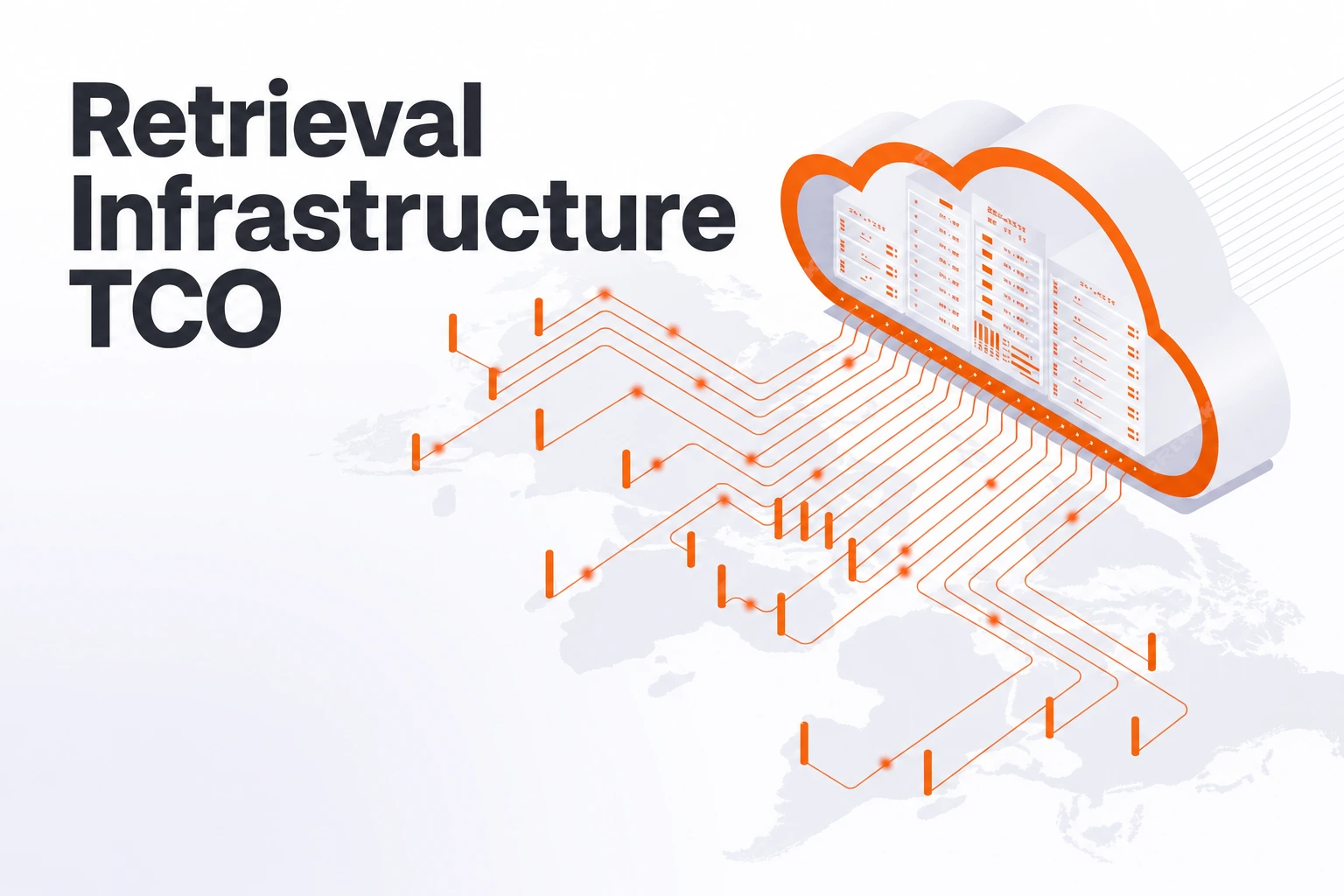
Enterprise retrieval TCO is the one-time setup and migration, recurring platform and infrastructure costs and model usage, operations labour, and planned changes and exit costs over a chosen period. The mix depends on workload and operating model. Use this framework to estimate and compare equivalent end-to-end scopes.
Key takeaways
What to include in enterprise retrieval TCO
- Full-period cost: Add setup and migration, recurring platform/infrastructure and model usage, operations labour, and planned changes and exit costs.
- Comparable assumptions: Use the same period, corpus size and change rate, query volume, availability target, and retrieval-quality target for each option.
- Workload-specific mix: Database, pipeline, network, agent, and labour costs vary with the scope; include only the services needed and avoid counting bundled features twice.
- Planned change scenario: Estimate index work separately from embedding generation, and include temporary overlap and operator time where your change plan requires them.
The cost lines to include
The AWS Cost Optimization pillar frames cost around the whole workload, not a single service. Start with this formula:
TCO over a chosen period = one-time setup/migration + recurring platform/infrastructure and model usage + operations labour + planned changes and exit costs
Choose one comparison period and use the same assumptions for every option: corpus size and growth/change rate, query volume, required availability, and retrieval quality. Label these as workload assumptions, not vendor prices; apply current official prices or quotes only to the matching usage assumptions.
| Cost line | What to estimate |
|---|---|
| Source, raw-file storage and protection | Corpus size, growth, retention, backups, restore testing, and storage kept for recovery. |
| Parsing, chunking and embedding | File/page mix, OCR and parser work, chunks processed, source-change rate, and any planned model change that needs new vectors. |
| Retrieval database and availability | Index and query resources, replicas or high availability, disaster-recovery capacity, and the capacity needed for the retrieval-quality target. |
| Sync, network and data movement | Change-detection and sync jobs, network transfer and egress, migration traffic, and any dual-running period. |
| Access, observability and support | Access controls, audit, logs, metrics, alerts, and the support scope included in the selected arrangement. |
| Query and agent serving | Retrieval/query usage and any reranking. Add agent inference and tool calls only for an answering-agent scope; do not add a separate charge for a capability already bundled into a platform line. |
| Setup and operations labour | Integration and configuration, upgrades, on-call, incident response, restore tests, and migration or cutover work. |
| Planned changes and exit | Index rebuild or model migration, temporary overlapping storage and compute, operator time, export, and migration away from the service. |
Use one set of workload assumptions across options and apply current official prices or quotes only to the matching usage assumptions.
Three ways to build the stack
Open-source assembly. A team might combine Docling for document conversion, pgvector or self-hosted Qdrant for vectors, and a framework such as LlamaIndex for loading, indexing, storing, querying and evaluation. Estimate the infrastructure and team time needed to integrate and operate the selected components.
Cloud-managed assembly. A managed vector database such as Pinecone can be one component alongside separately selected services for parsing, embedding, sync and agent serving. Estimate usage and operating effort for the full scope you choose.
Integrated platform. Seahorse Cloud combines S3-compatible object storage with VLM, OCR and LLM-based document parsing, semantic chunking and automatic vector-database sync. Its managed agents support MCP-standard tool calling, an inference endpoint API and usage tracking. This can bring document processing, sync and agent capabilities into one platform scope; include the platform’s applicable usage and the team time to configure and operate the chosen setup, without separately counting bundled features.
Costs that appear after launch
Rebuilds are the easiest cost to miss. In Seahorse Cloud, embedding endpoints and HNSW parameters are fixed when a Storage is created; changing them means a new Storage and moving the files. Keep index rebuild work separate from embedding generation. Do not assume every index-setting change requires new embedding calls; include them only when the planned change and the selected system’s migration process require new vectors. For a planned model change, scope any vector generation, validation and cutover as a separate migration scenario. For a Seahorse Storage replacement, include any temporary overlap in storage/compute and operator time for validation and cutover, and budget reprocessing only if the chosen workflow requires it. Test settings on a sample first.
Upload limits shape preparation work too. Seahorse Storage accepts up to 100 MiB per file and rejects unsupported extensions at upload, so oversized scans need splitting before ingestion.
Separate hosting, delivery and operations
The Seahorse Cloud product page lists an on-premises installation and a SaaS subscription. Treat hosting location, service delivery and operator responsibility as separate questions: for the specific offering, confirm where it runs, how it is provided, and which tasks the customer or supplier handles, such as cluster operations, upgrades, backups and incident response. Include the corresponding infrastructure or service costs and staff time in the comparison.
Compare equivalent end-to-end scopes over the same period, then choose based on the largest real cost drivers in your workload—not a universal cost ranking.
FAQ
Is a vector database price comparison enough for retrieval TCO?
No. Include the full scope you need, such as document processing, storage, network, availability, access controls, agent serving when applicable, and operations. The cost mix depends on workload and operating model, so compare equivalent scopes rather than assuming other pipeline costs are higher.
How should we estimate index rebuilds and re-embedding?
Estimate index-build resources separately from embedding generation. Do not assume every index change needs new vectors; include re-embedding, temporary overlap, and operator time only where the planned change and the selected system’s workflow require them.
Does on-premises hosting always mean our team operates everything?
No. Seahorse Cloud lists on-premises installation and SaaS subscription options, but hosting, service delivery and operating responsibility are separate questions. Confirm the responsibilities for the specific offering and arrangement.
Map your pipeline in one place
Review storage, vector database and agent settings in the Seahorse Cloud console.